

 Photo:
Neither one is just a page builder.
Choose HighLevel first if your site needs to turn enquiries into consultations, estimates or repeat purchases and you want funnels, CRM and follow-up alongside a store. Choose Shopify first if the main business is selling, packing, shipping and managing products across channels and stock locations. Both can run an online storefront.
HighLevel vs Shopify: feature-by-feature comparison
The descriptions below are based on current vendor documentation. They are not scores or performance claims from our own testing.
| Buyer decision | HighLevel | Shopify |
|---|---|---|
| Best starting point | Service-business website, lead capture, funnels and follow-up | Online store centred on products, orders and retail |
| AI-assisted design | AI Studio builds and revises projects from plain-language prompts; ecommerce storefront templates | AI-supported storefront generation plus customizable commerce themes |
| Storefront & checkout | Online stores with product pages, cart, checkout, payments and order management | Dedicated commerce storefront and checkout |
| Products and inventory | Sell physical and digital products; verify stock, shipping and inventory needs in your account | Product/catalogue operations and inventory by location are core workflows |
| Funnels and automated follow-up | Built-in funnels, CRM and multi-step follow-up are central strengths | Marketing automation through Shopify tools and its broader app ecosystem |
| Retail & POS | Test integrations and in-person needs before choosing | Shopify POS and connected online/in-person inventory |
| Website templates | Large website/funnel template collection plus AI Studio templates | Large commerce theme collection plus AI website features |
| SEO | Publishable sites; AI Studio's advanced SEO setting needs setup/republish | Commerce-oriented storefront SEO tooling and editable site content |
| Operational trade-off | Consolidates marketing and web tools, but retail depth needs validation | Strong commerce operations, with app costs and marketing-tool overlap to assess |
The initial pivot was out of desperation, honestly, just to save money.
HighLevel AI Studio: prompts, templates and ecommerce storefronts
HighLevel AI Studio is a conversational builder. Describe the site you want, use a template or provide a reference URL or image, then request edits in natural language. Official documentation lists ecommerce storefronts among its templates. That is a genuine advantage for a business owner who wants to start from an idea and iterate without manually building every block.
AI Studio also supports publishing to a preview address and connecting a custom domain. Its documentation separately explains how existing HighLevel products, prices and payment setups can power checkout experiences in AI Studio projects. But AI Studio is its own publishing environment: do not assume every classic Websites or Funnels editor feature automatically appears in the AI Studio experience.

Start with a real brief, not a mock-up.
Ask for a five-page business site or a small ecommerce storefront. Refine the mobile menu, product copy and CTA placement, then test a live checkout or lead form before declaring the website finished.
HighLevel ecommerce editor, shown in its light interface. AI Studio is a separate builder. Original source ↗From a brief to a first draft—without a weeks-long design handoff.
HighLevel’s new AI Studio lets a founder describe an idea, select an ecommerce template, bring reference imagery and refine layouts conversationally. It can generate the bones of a site surprisingly quickly, although a real launch still needs content, payment, mobile and SEO testing. The shift for a small business is substantial: an initial site that once involved weeks of briefing, design and development can now take shape in minutes. You can try an idea, change direction and see the result in the same session. A finished store still needs your products, payments and launch checks.
See the documented AI Studio workflow ↗ · HighLevel store builder overview ↗
Can HighLevel actually replace Shopify for an online store?
For some businesses, yes. HighLevel now documents a proper store workflow: products, collections and detail pages, a cart, checkout and order confirmation, payment-provider connections and order management. It provides pre-built ecommerce sections and store templates. Stores can also be added to funnels, allowing an advert or landing page to lead into product discovery and purchase without leaving the marketing journey.
That is especially relevant for businesses selling a manageable set of products alongside appointments, services, courses or lead-generation campaigns. HighLevel supports physical and digital products as well as one-time and recurring pricing, but you still need to validate product variants, shipping, taxes, returns and the exact payment providers that apply to your operation.
Where Shopify may justify a dedicated subscription: Shopify is built around the product catalogue, inventory, checkout, orders and retail channels. Shopify documents inventory management across multiple stock locations and fulfillment apps; its POS ecosystem is intended to connect online and in-person sales. Those operations can matter much more than page-builder speed when a retailer scales.
HighLevel deserves a serious test for…
- A service company that sells a few products while booking jobs and following up leads.
- An agency creating funnels, landing pages and client-facing ecommerce offers.
- A business with one-time or recurring offers and email/SMS follow-up.
- A store whose marketing funnels and customer conversations need to be tightly connected.
Shopify deserves a serious test for…
- A retailer with large or growing product catalogues and variant-heavy inventory.
- A business managing more than one stock or fulfillment location.
- A store selling online and in person through a connected POS workflow.
- A product brand relying on commerce apps, fulfillment and multichannel operations.
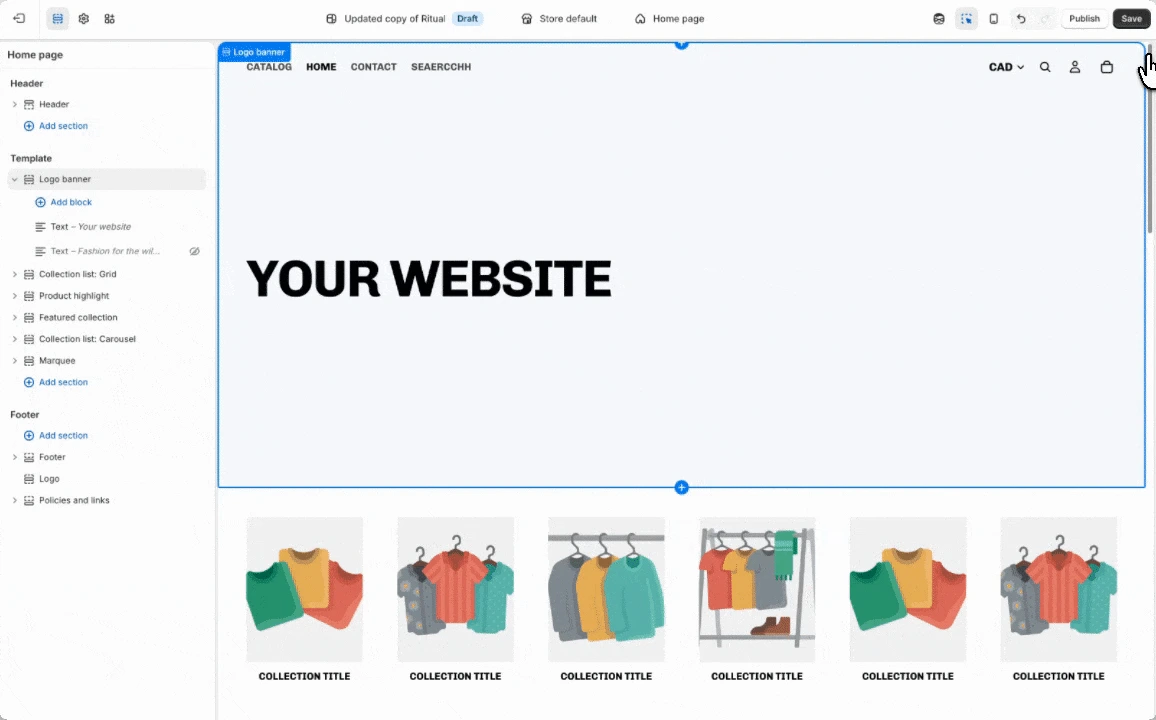
Test the back office as carefully as the storefront.
Try a 30-product catalogue, three variants, two stock locations and a real return. That often reveals more than a beautiful homepage demonstration.
Still frame from Shopify’s official theme-editor demonstration. No animation. Original source ↗I truly believe brands take time to build. You don’t build a brand overnight.
HighLevel website builder vs Shopify: which fits better?
For a local business website that needs an enquiry form, calendars, automated replies and follow-up campaigns, HighLevel can reduce the number of separate tools involved. Standard HighLevel Websites and Funnels also have reusable templates; AI Studio introduces a separate prompt-first way to build and publish digital experiences.
Shopify also offers AI-powered website creation, customizable themes, managed hosting, a checkout and a substantial app ecosystem. For a store-first business, these are not afterthoughts. A Shopify site can have strong brand pages and content; the platform simply prioritizes the shopping journey and commerce operations.
One easy trap: comparing HighLevel AI Studio’s brand-new site-generation flow with Shopify’s traditional theme editor alone. Both have AI tools and templates; evaluate the latest workflows, then use the same design brief and the same store requirements to compare fairly.
SEO and Google indexing: what should website owners check?
Neither product comes with a guaranteed Google ranking. Page speed, useful content, titles, internal links, canonical URLs, sitemap quality and structured data all affect search visibility independently of the editor used. HighLevel documents an Advanced SEO Support setting for AI Studio projects that must be enabled and republished in the relevant setup. Shopify offers search and navigation, content and SEO features around its hosted storefront.
For a real comparison, publish a test page on the intended domain. Inspect the rendered HTML, title, description, canonical, indexability, image alt text, mobile experience and the sitemap. Also verify whether product and collection pages can express the content hierarchy you need.
Shopify's data is pure and consistent. We spend less time sifting through sources and more time understanding our customers.
HighLevel vs Shopify pricing: compare the full stack
Headline monthly fees are not directly comparable because they cover different jobs. HighLevel includes substantial CRM and marketing functionality alongside sites and stores; Shopify packages a commerce platform with its own plan, payment and app economics. Availability, paid add-ons, AI usage, payment fees and plan allowances can change. Verify the current US prices at checkout.
For HighLevel, calculate the account plan, any AI Studio usage or add-ons, messaging/phone consumption, payment processing and the time required to build customer automations. For Shopify, include the store plan, payment processing, premium apps, themes, POS and any external CRM or marketing automation you need.
It is entirely possible for HighLevel to reduce overlapping subscriptions for a funnel-led business; it is also possible for Shopify to save operational time for a product-heavy business. Neither savings claim is universal, so do not treat an affiliate commission or a generic starting price as a buying verdict.
Frequently asked questions
Can HighLevel build an ecommerce store?
Yes. HighLevel supports online stores with product listings, carts, checkout, payment-provider connections and order management. It also offers ecommerce store templates and a store experience within funnels. Test required inventory and fulfillment workflows before switching platforms.
Does HighLevel AI Studio build stores from prompts?
AI Studio supports conversational website creation and an ecommerce storefront template. Its payment documentation describes product and checkout configuration. Publishing from AI Studio is a separate path from the classic Websites and Funnels builders; do not assume all editor features are interchangeable.
Is HighLevel better than Shopify for ecommerce?
It depends on the selling model. HighLevel is attractive when selling is closely tied to lead capture, CRM, appointments and automated follow-up. Shopify is usually the more natural first test when product catalogue, inventory, shipping, locations and retail channels drive the business.
What is vibe coding in HighLevel AI Studio?
Vibe coding means describing what you want the AI to build, then refining it through conversation. In AI Studio, that can mean a business website, landing page or ecommerce storefront, with follow-up prompts to change the design and functionality.
Which platform is better for SEO?
Both can produce public websites, but SEO outcomes depend on the site's content, crawlability, structure and implementation. HighLevel documents advanced SEO support for AI Studio, while Shopify has commerce-oriented content and storefront tools. Test metadata, rendered HTML, canonical URLs, schema and performance on the exact published setup.
Sources and editorial methodology
Reviewed 18 October 2026. This is an independent, source-led comparison—not a hands-on software test, not a measured ranking and not a claim that an integration or feature works in every plan or region. Features and prices change; verify your own account and contract.
- HighLevel AI Studio overview ↗
- HighLevel online store setup ↗
- HighLevel ecommerce templates and store builder ↗
- HighLevel AI Studio payment and checkout setup ↗
- HighLevel ecommerce stores inside funnels ↗
- HighLevel AI Studio advanced SEO ↗
- Shopify website and AI builder ↗
- Shopify multi-location inventory ↗
- Shopify US pricing ↗
- HighLevel published customer case study · James Bonadies ↗
- Shopify founder story · Sara Sugarman ↗
- Shopify merchant story · Nanette Wong ↗
Related: HighLevel full review, Shopify full review and Shopify vs Wix.