Start with the verb, not the vendor.
Choose monday.com first if the problem is delivery: projects slipping, nobody sure who owns what, deadlines living in spreadsheets. Choose GoHighLevel first if the problem is revenue: enquiries going unanswered, follow-up depending on memory, bookings and reviews scattered across tools. If both problems are real, that is not a contradiction — it is the most common reason teams end up with both, and we say so plainly below.
monday.com vs GoHighLevel: feature-by-feature comparison
The descriptions below are based on current vendor documentation. They are not scores or performance claims from our own testing. Prices are annual-billing figures; monthly billing exists for monday.com but is not quoted here.
| Buyer decision | monday.com | GoHighLevel |
|---|---|---|
| What it started as | A work board: tasks, projects and deadlines any department can bend to its process | A CRM: selling, lead capture and follow-up for agencies and service businesses |
| The job it runs | Your WORK: delivery, projects, operations, HR, product work | Your SELLING: enquiries, pipelines, follow-up, bookings and repeat business |
| Pipelines | Board-based pipelines; the sales pipeline lives in monday CRM, a separate product | Pipelines built into the same customer record as calls, messages and bookings |
| Calls, SMS and email | Email and an activities timeline in monday CRM; phone and SMS need integrations or separate tools | Calls, SMS and email in one customer record, with funnels and automated follow-up |
| Funnels, websites, calendars, reviews | Forms and boards; no funnel builder, website builder, booking calendar or review-request engine to match | Funnels, websites, calendars and review requests built in |
| Project management | Genuine project management: dependencies, workload view, Timeline and Gantt views | Task tracking inside client delivery; not a project-management suite |
| Life beyond sales and marketing | Operations, HR, product and delivery teams all have a home here | Built for the front office of a trades, clinic or agency business; other departments have no real home |
| Agency model | Per-seat billing; no sub-account resale model | Sub-accounts let an agency run each client separately, with white-label and SaaS resale on higher tiers |
| Pricing shape | Per seat, paid plans from 3 seats; a free plan and a $9 annual entry point | Flat per account with unlimited users; $97 a month for Agency Starter, plus message and call usage |
| Trial | Free plan, plus a 14-day Pro trial | 14-day trial; no free plan |
| Automation allowance | Work Management Standard: 250 automation and 250 integration actions per seat per month; Pro: 25,000 each | Workflows included in the account; messages, calls and AI usage are billed on top of the plan |
| Honest best fit | A team that needs to run its work visibly and on time | A business that needs to win, follow up and rebook customers from one front office |
Why buyers confuse them (fairly)
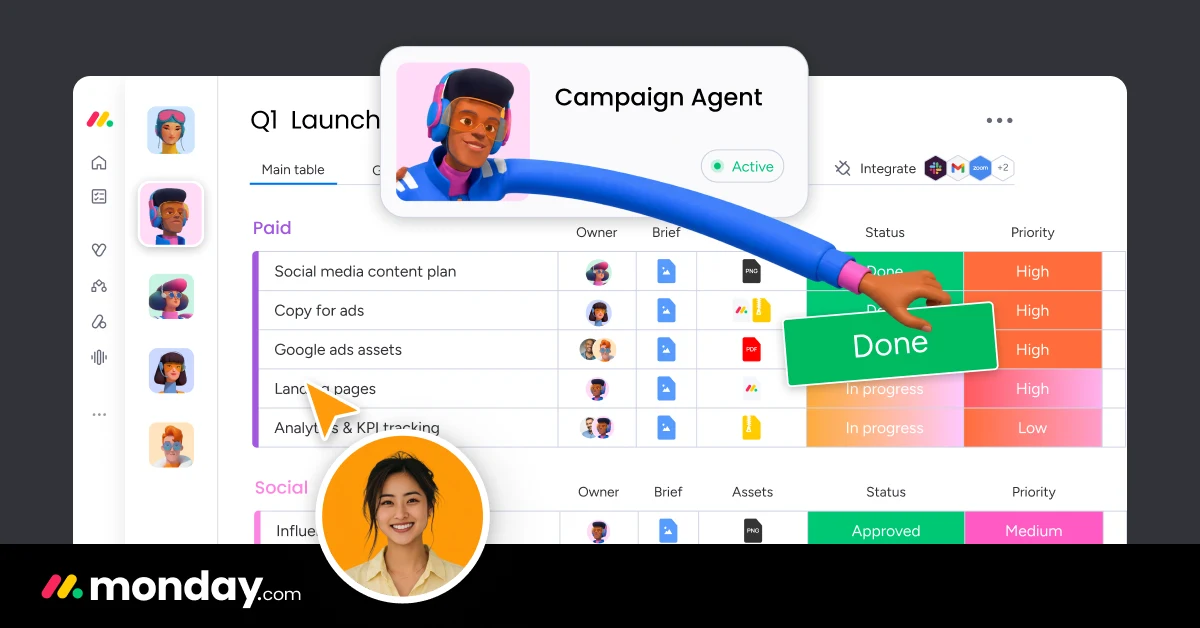
The overlap is real, and pretending otherwise would be dishonest. Pipelines, automations, dashboards, forms and templates exist in both. A freelancer tracking leads in monday CRM and an agency tracking delivery in GoHighLevel can look deceptively similar in a screenshot — coloured columns, moving cards, a dashboard at the top.
The tell is what happens after the card moves. In monday.com, the next step is usually a task: someone owns it, it has a deadline, it may block something else. In GoHighLevel, the next step is usually a message: a call, a text, an email, a booking link, a review request. Same board shape, different verb. If you cannot say which verb your business is missing, you are not ready to buy either — run the trial test at the bottom of this page first.
Where GoHighLevel honestly wins
Client-communication depth is the gap that matters most. Calls, SMS and email live in one customer record in GoHighLevel, with funnels, websites, calendars and review requests built in rather than bolted on. A trades or clinic business can genuinely run its front office on it: enquiry in, call back, text reminder, booking confirmed, review requested, repeat.
The agency model is the second win, and it is structural, not cosmetic. Sub-accounts let an agency run each client as a separate account, and higher tiers add white-label and SaaS resale — the agency sells the software as its own product. monday.com has no equivalent: every seat bills, and there is no client-account resale shape to speak of.
Flat pricing is the third win, for the right buyer. One location pays $97 a month for Agency Starter no matter how many staff log in — plus message and call usage, which is the honest caveat and the part most summaries skip. A ten-person front desk costs the same headline price as a one-person one.
Where monday.com honestly wins
Genuine project management is the headline. Dependencies, a workload view and Timeline and Gantt views are not marketing words on monday.com; they are the product. A delivery team can see what is blocked, who is overloaded and what slips if a date moves. GoHighLevel tracks tasks, but asking it to run a complex delivery operation is asking a CRM to be a project suite. It will comply, and you will regret it.
Life beyond sales and marketing is the quieter win. Operations, HR and product teams have a home in monday.com because a board can be bent to almost any process. In GoHighLevel they do not: the whole platform assumes the job is winning and keeping customers. That is a fine assumption for a clinic or a trades firm. It is a bad one for a company whose bottleneck is shipping work, not winning it.
Then there is the price of admission. monday.com has a free plan (up to 2 seats, up to 3 boards) and a $9 annual entry point on Basic, against a $97 flat start for GoHighLevel. A solo operator or a two-person team can start on monday.com for nothing, or nearly nothing, and find out whether boards help before spending real money. GoHighLevel asks for $97 from day one — reasonable for a business replacing four tools, steep for a business that only needs one board.
Cost shapes, worked with numbers
These two do not just cost different amounts. They cost in different shapes, and the shape decides who overpays.
monday.com Work Management, Standard, annual billing
- 5-person team: 5 × $12 = $60 a month.
- 9-person team: 9 × $12 = $108 a month — past GoHighLevel’s $97 headline before any usage.
- Solo buyer on monday CRM Basic: the 3-seat minimum still bills 3 × $12 = $36 a month.
- The trap: Work Management plus monday CRM bills twice — 5 seats of each on Standard is 5 × $12 + 5 × $17 = $145 a month.
GoHighLevel Agency Starter
- One-location business: $97 a month flat, unlimited users, 3 sub-accounts.
- A 10-person front desk pays the same $97 headline as a 1-person one.
- The caveat: phone, SMS, email and AI usage are billed on top — the real bill is $97 plus whatever your follow-up actually uses.
- The trap: paying $97 for breadth you never switch on, when a free monday.com board would have done.
The crossover is the point most comparisons skip. On Standard alone, monday.com passes GoHighLevel’s $97 headline at 9 seats ($108). Below that, per-seat billing wins; above it, flat billing starts to look like a bargain — provided the business actually uses the selling tools, and provided usage charges do not eat the difference. Run your real seat count and your real message volume through both before deciding; adjectives will not do this arithmetic for you.
The close nobody else writes: often, it is both
Agencies frequently end up with both tools, and there is nothing indecisive about it. GoHighLevel runs clients’ front offices — leads, follow-up, bookings, reviews, one account per client. monday.com, or a rival, runs the agency’s own delivery — who is building what, what is blocked, what ships this week. One faces the customer, the other faces the work, and neither is very good at the other’s job.
And some businesses need neither as their second tool. A solo tradesperson with a full diary needs GoHighLevel’s follow-up, not a project suite. A product team with no outbound sales needs monday.com’s boards, not a funnel builder. Buying the second tool because a comparison page told you to is how a $60 stack becomes a $157 stack with nothing to show for it. The honest test is embarrassingly simple: which problem cost you money last month — work slipping, or customers slipping away? Buy that one first.
Try before you buy: one afternoon, both trials
Run the same job through both. In monday.com, build a board for a real project with an owner, a dependency and a deadline, then move the deadline and watch what breaks. In GoHighLevel, take a real enquiry from first message to booked appointment to review request, and count how many other tools you would still need. Whichever trial felt like work you already do — not work you admire — is the one to pay for.
Related: monday.com full review, HighLevel full review, HighLevel vs HubSpot and HighLevel vs Shopify, Monday.com buyers guide and How much does Monday.com cost?.
Frequently asked questions
Is monday.com a CRM?
Not quite. monday.com sells monday CRM as a separate, separately billed product built on the same platform. Work Management is the project and work product; monday CRM is the sales pipeline product. Buying one does not automatically buy the other, and each bills per seat.
Can monday.com replace GoHighLevel?
Only if your job is tracking work rather than running client communication. monday.com is strong at boards, projects, deadlines and dashboards, but it has no built-in funnel builder, website builder, calendar booking, review-request engine or native phone and SMS inbox to match GoHighLevel's front office.
Can GoHighLevel replace monday.com?
Only if your job is selling and client follow-up rather than delivering complex work. GoHighLevel runs lead capture, pipelines, calls, SMS, email, funnels, calendars and reviews in one customer record, but it is not a project-management suite: no genuine dependency planning, workload view or Gantt depth to match monday.com.
Why do the two look similar in screenshots?
Both show pipelines, automations, dashboards, forms and templates. A freelancer tracking leads in monday CRM and an agency tracking delivery in GoHighLevel can look deceptively alike at a glance. The difference is what each record is built to do next: move work forward, or move a prospect toward a sale.
How do monday.com and GoHighLevel prices compare?
They curve differently. monday.com Work Management bills per seat per month on annual billing (Standard $12), with paid plans starting from 3 seats, so a 5-person team on Standard pays $60 a month. GoHighLevel Agency Starter is a flat $97 a month for one account with unlimited users, plus message and call usage. Small teams usually pay less on monday.com; larger teams can pass GoHighLevel's headline price on per-seat billing alone.
Do agencies end up using both?
Often, yes. A common split is GoHighLevel running each client's front office (leads, follow-up, bookings, reviews) while monday.com, or a rival, runs the agency's own delivery: who is doing what, by when, and what is blocked. Some businesses need neither as a second tool.
Sources and editorial methodology
Reviewed 24 October 2026. This is an independent, source-led comparison—not a hands-on software test, not a measured ranking and not a claim that an integration or feature works in every plan or region. Features and prices change; verify your own account and contract. No affiliate rate is published for either programme.
- monday.com Work Management pricing ↗
- monday CRM pricing and plans ↗
- monday.com work platform overview ↗
- GoHighLevel pricing ↗
- GoHighLevel platform overview ↗
Related: monday.com full review, HighLevel full review, HighLevel vs HubSpot and HighLevel vs Shopify, Monday.com buyers guide and How much does Monday.com cost?.