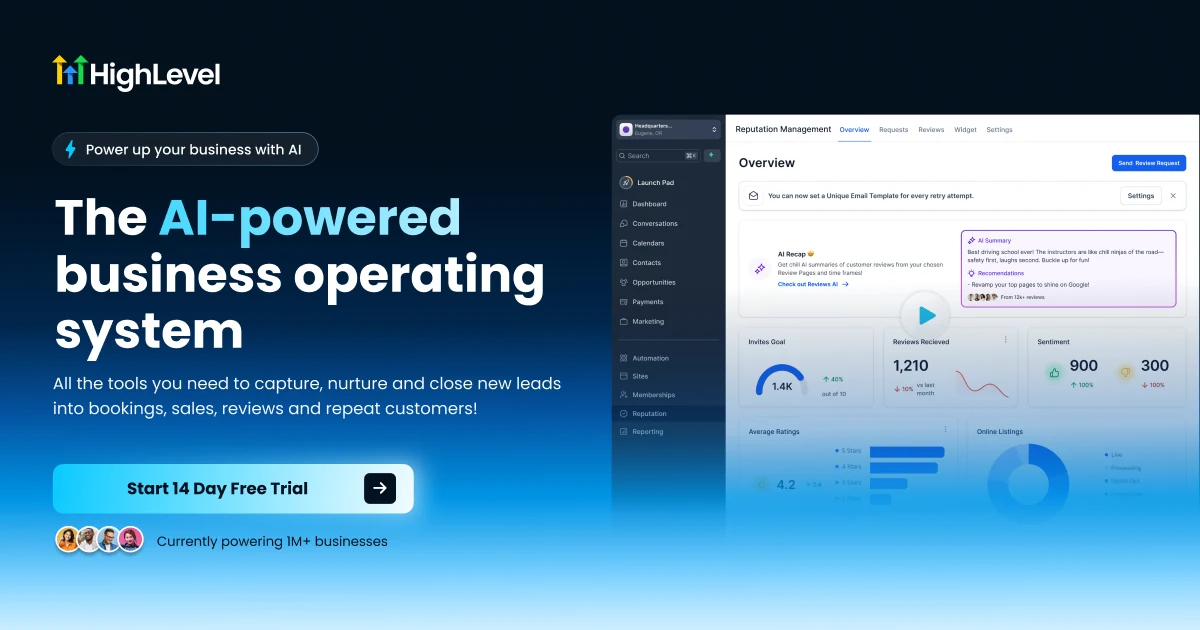

Why is HighLevel especially relevant to marketing agencies?
Agencies often manage the same commercial workflow repeatedly: capture a lead, qualify it, book a call, nurture the opportunity, launch a funnel, follow up contacts and report back to the client. HighLevel can consolidate a meaningful portion of that front-office and campaign infrastructure, particularly when the agency wants reusable processes across client accounts.
The trade-off is operational discipline. A broad platform can reduce subscriptions but it also becomes a system your team must configure, govern and support. Creative production, deep project management, specialist analytics or advanced advertising workflows may still live elsewhere.
What could HighLevel replace here?
Separate CRM
Run agency leads and, where appropriate, client lead pipelines without another standalone CRM.
Basic funnel builder
Create landing pages and forms that connect directly to the same contact and automation layer.
Appointment-booking tool
Use calendars for sales calls, onboarding calls or client-specific booking workflows.
Email/SMS automation tools
Build nurture, follow-up and reactivation inside the same platform.
Review / reputation tool
Support review-request workflows for suitable local-business clients.
Several glue tools
Reduce some of the handoffs between form builders, CRM, calendars and follow-up systems.
What HighLevel should not automatically replace
Project and creative delivery
Complex production schedules, approvals, asset management and delivery workflows may be better handled in a dedicated project platform.
Specialist reporting and ad operations
Advanced BI, attribution, media buying and channel-specific campaign management can still require specialist systems.
A sensible marketing agencies stack
Run CRM, funnels, forms, booking, nurture and repeatable client-facing automations.
Manage the agency's internal production, tasks, approvals and deadlines.
Keep agency finances and any specialist analytics in systems designed for those jobs.
The agency case is less about adding HighLevel to everything and more about deciding what it can replace. The more repeatable your client acquisition and local-business workflows are, the stronger the consolidation case.
Who should test it first?
Check the fit
Strong when one platform can replace several subscriptions and reduce manual handoffs.
Check the fit
Particularly relevant when clients need lead capture, missed-call follow-up, booking, nurture and review workflows.
Check the fit
More selective: use HighLevel only where it beats the existing CRM/funnel stack without weakening delivery or reporting.
How to test HighLevel in 14 days
- Build the agency's own lead-to-call pipeline first before touching a client account.
- Create a reusable form, booking and follow-up workflow and clone it into a test client setup.
- Check permissions and separation so one client's contacts, automations and assets cannot spill into another's workflow.
- Run a missed-call or web-lead test and inspect the full customer experience.
- List the subscriptions HighLevel would actually replace and the ones that still need to remain.
- Assign an internal owner for templates, automations, QA and client support before scaling the setup.
HighLevel for marketing agencies: bottom line
For marketing agencies, HighLevel can be more than a single-purpose tool: it can become the commercial and automation layer across repeatable client workflows. The win comes from genuine consolidation and standardisation—not from forcing project delivery, creative work or specialist reporting into a platform that is not the best fit for those jobs.