Monday AI: the quick facts
Which AI tool, for which job
Four tools share one name — “monday AI” — and they are not interchangeable. Pick by the job, not by the demo that impressed you most.
| Your job | Reach for | Why |
|---|---|---|
| A quick question about live work, right now | Sidekick | A chat assistant with board context: ask what is overdue, draft the update, change the item. |
| The same job, every day or every week, without asking | An agent | Configured once, then runs on its own schedule: scoring, triage, risk flags, summaries. |
| One small AI step inside a column, at scale | AI blocks | Categorise, summarise, extract or translate, at a flat 8 credits per action. |
| A chain of AI steps that must run in order | AI workflows | Multi-step automations; capped at 3 active workflows on Standard, 20 on Pro. |
| Meetings you need notes and owners from | AI Notetaker | Transcription, summary and action items at 120 credits per meeting hour. |
| An internal tool that does not exist yet | monday vibe | Describe the app in plain language and it builds it — then charges by the build and the run. |
Notice the pattern: Sidekick is the assistant you talk to, agents are the workers you set running, blocks are the piecework, and vibe is the builder. Confusing them is how a team buys an assistant and then wonders why nobody is doing the recurring work.
What the AI layer actually is, in October 2026
Start with the model change, because it reframes everything else. For customers who joined the monday AI work platform on or after 6 May 2026, monday.com sells seats and AI credits together: seats cover the people, credits cover the AI usage, and the two are bought as required parts of the same setup. Older accounts may be on different arrangements — if yours predates that date, your signup terms, not this page, describe your deal.
The credits sit in one shared pool for the account. Agents, Sidekick, AI blocks, AI workflows, the Notetaker and vibe all draw from it, which is genuinely simpler than a separate add-on for each feature — and genuinely easier to drain by accident, because no single feature's price tag warns you about the others. Admins can watch the pool in the AI governance section of Administration, and monday.com sends notifications at 80% and 100% of usage. Treat the 80% warning as the budget meeting, not background noise.
Two more facts belong in the first paragraph of any honest AI page. AI features are available for paying accounts, not for free accounts — the free plan's $0 price buys boards, not an AI workforce. And the credit pool does not scale with headcount: buying more seats does not buy more credits. A bigger team on the same bucket is a hungrier team on the same food, which is a sentence worth reading twice before checkout.
| Work Management, annual billing | Seat price per seat per month | Minimum AI credits per month |
|---|---|---|
| Free | $0 | No AI credits — AI features are not available on free accounts |
| Basic | $9 | 1,000 |
| Standard | $12 | 2,000 |
| Pro | $19 | 3,000 |
| Enterprise | Custom | Contact monday.com sales |
Seat prices checked against monday.com's pricing page on 24 October 2026 (US edition, annual billing). Paid plans start from 3 users, so the smallest paid Standard team pays $36 a month in seat charges for a 2,000-credit pool. Larger credit buckets are purchasable without changing the seat count: Standard offers 2,000, 4,000 or 8,000 a month; Pro offers 3,000, 4,000, 8,000 or 20,000. Monthly-billing seat prices are not printed here because they were not verified from the pricing toggle at build time.
Sidekick: the assistant with a daily ration
Sidekick is the conversational layer: a context-aware assistant inside the workspace that reads your boards, docs, teammates and connected apps, answers questions about live work, and — this is the part that separates it from a chatbot — takes actions. Ask what is overdue this week, tell it to create an item and assign it, have it tag a teammate, draft the email, or build a chart from the board. It respects existing permissions, so it only touches data the person asking could already see, which is reassuring in exactly the way a permission bug would not be.
Then comes the ration. Sidekick Lite, included with Standard and Pro, allows 5 messages a day per user, within a single workspace, resetting daily. Five messages is not an assistant you build a habit around; it is a lookup you ration — one status check, one draft, one board change, and the day's allowance is more than half gone. Monday's own guide lists basic Sidekick interactions within the Lite daily limit among the features that run without consuming credits, which makes Lite a small daily free sample of the assistant rather than a draw on the pool. The catch is the size of the sample, and the single-workspace scope: a team spread across workspaces will feel the boundary before it feels the benefit.
| Sidekick tier | Included with / purchasable on | Messages per user per day | Context scope |
|---|---|---|---|
| Sidekick Lite | Standard and Pro | 5 | Single workspace |
| Sidekick Plus | Enterprise included; purchasable on Standard and Pro | 100 | Account-wide |
| Super Sidekick | Purchasable on Standard, Pro and Enterprise | 500 | Account-wide |
Tier limits from monday.com's AI guide. Plus and Super also allow a small daily number of images or videos (2 and 10 respectively, per that guide).
Sidekick's credit meter, for everything beyond Lite
Once Sidekick work is credit-metered, monday.com's catalog prices each message by complexity — and the range is wide enough to matter. A simple message, a quick question or a single small board change, runs about 10–30 credits. An intermediate one, a chart or a board built from a brief, runs about 30–80. A complex one, cross-board analysis or a full dashboard, runs about 80–150. An extra-complex one, a batch update across hundreds of items or a full board rebuild, runs 150+ credits. The cost depends on how much board context the request reads, how many tools it invokes, and how long the conversation runs — which is a polite way of saying that a vague question asked of a large board is the most expensive question on the page.
The practical consequence is that Sidekick has two meters and they bite in different ways. Lite bites by count: five messages, then stop. Credit-metered Sidekick bites by depth: one ambitious request can cost more than a week of simple ones. A team that treats Sidekick as a daily research assistant, asking cross-board questions every morning, will learn this from the 80% notification. A team that treats it as a quick lookup tool may never meet the meter at all — which, for a Standard account with 2,000 credits, is arguably the intended lesson.
Agents: workers you configure once, then leave alone
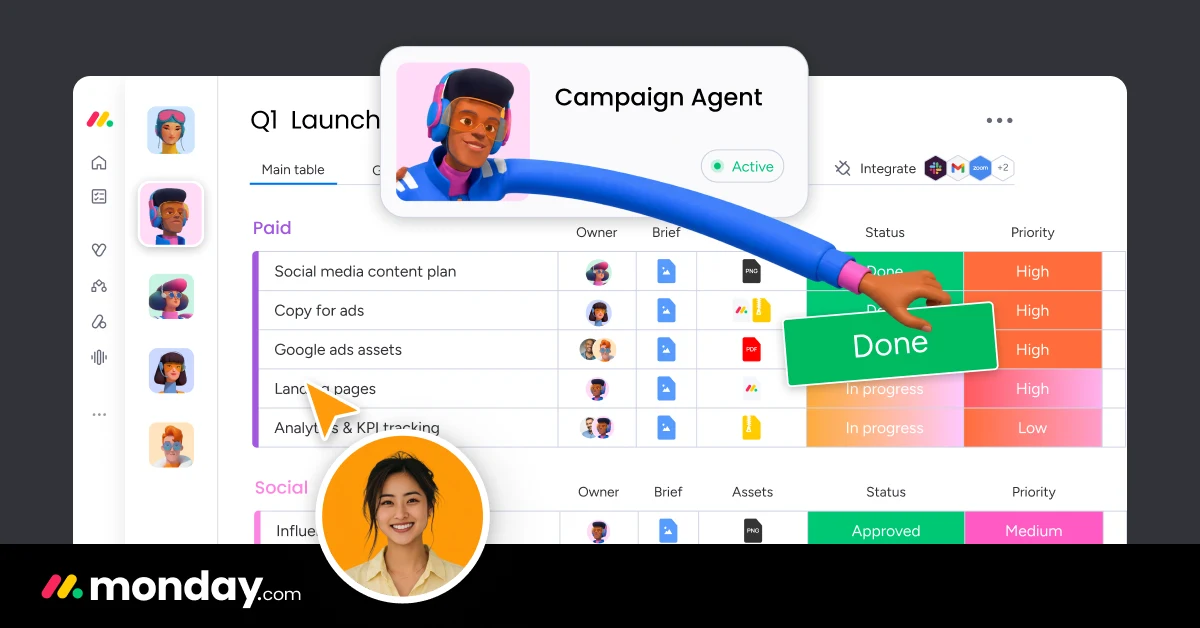
Agents are the other half of the story, and the more consequential one. Where Sidekick answers in the moment, an agent is a specialist worker configured once — role, knowledge sources, triggers, actions — that then runs on its own schedule: scoring leads, triaging tickets, flagging risks, summarising meetings, without anyone asking twice. Monday.com ships prebuilt agents for the common jobs across sales, marketing, operations, IT and HR, and a builder that creates custom agents from prompts alone, with no code required. The named examples in monday.com's own guide give the flavour: Lead Scorer (scores leads on fit, intent and engagement), Ticket Assignment (detects a ticket's intent, urgency and required expertise), Risk Analyzer (detects schedule, dependency and workload risks across projects in real time) and Meeting Summarizer (creates meeting notes, transcripts and summaries).
The honest caveat is the same one that applies to every agent product: an agent is worth roughly what your board discipline is worth. It reads the boards, docs and forms you point it at, and it acts within the permissions you give it. A tidy board with consistent statuses produces a useful agent; a board where statuses mean whatever the last editor felt like produces an agent that confidently automates the mess. Test any agent on a non-critical board first, watch what it actually changes, and only then let it near the pipeline that pays the bills.
| Agent task complexity | Credits per task, per monday.com's catalog | What it looks like |
|---|---|---|
| Simple | ~10–50 | A single straightforward task on well-structured data |
| Intermediate | ~50–150 | A multi-step task, or one that reads moderate board context |
| Complex | ~150–250 | Research, reporting, or a task spanning several steps and sources |
| Extra complex | ~250+ | Multi-system work, or a run with many sequential steps |
Each agent run may include multiple tasks depending on the prompt, so a run's cost is the sum of its tasks, not a single row of this table. Budget per run, not per agent.
The worked example: a realistic month on Standard
Enough ranges. Here is one concrete month, with every assumption stated so you can rerun it with your own numbers. The team is on Standard, so the pool is 2,000 credits. The month is deliberately ordinary — no launch week, no crisis, no agent gone rogue — and it still uses 90% of the pool.
In plain words: the diagram is a single bar split into four slices. Agents take the biggest slice (800 credits, 40% of the pool), the AI Notetaker takes the next (600 credits, 30%), AI blocks take a fifth (400 credits, 20%), and only a thin slice is left over (200 credits, 10%). A month that looks modest in words — eight agent runs, fifty automated column actions, five hours of meetings — is a month that is nearly out of credits.
| This month's AI work | Assumption (inside monday.com's published ranges) | Credits |
|---|---|---|
| Agent runs | 8 intermediate runs, counted at 100 credits each — the middle of the 50–150 intermediate range | 800 |
| AI block actions | 50 actions on distinct items, at 8 credits each | 400 |
| AI Notetaker | 5 meeting hours, at 120 credits per hour | 600 |
| Total used | Against a 2,000-credit Standard pool | 1,800 |
| Headroom left | 10% of the pool, before any Sidekick beyond Lite | 200 |
Now watch how little it takes to break it. Four extra complex agent runs, at 200 credits each (inside the 150–250 complex range), add 800 credits and push the month to 2,600 — 600 over the pool. Five extra meeting hours add another 600 and push it to 2,400. A Sidekick habit is the fastest breaker of all: twenty intermediate Sidekick messages at 50 credits each is 1,000 credits on its own, half the month gone in conversation. None of these scenarios is exotic. Each one is a normal team having a slightly busier month than planned, and each one ends at the same place: the AI governance page, buying the next bucket up — 4,000 credits on Standard — or switching the agents off until the cycle resets.
The dry irony is worth stating: the team most likely to blow through 2,000 credits is the team for whom the AI is working best. Heavy usage is the success signal and the bill at the same time, which is why the worked example matters more than the feature list. Count your agent runs, your meeting hours and your block actions before you buy, not after the 80% notification arrives.
AI blocks, AI workflows, and the parts that cost nothing
Not everything metered is expensive, and not everything AI is metered at all. AI blocks — the prebuilt column functions for categorising, summarising, extracting, translating, detecting sentiment, writing and more — cost a flat 8 credits per action. That flatness is their virtue: they are the only AI cost on the page you can predict without a spreadsheet. One rule softens it further: all actions on the same item within a 24-hour period are counted once, though subitems count separately. Fifty actions on fifty items is 400 credits; fifty actions on one item in a day is 8, which is either a bargain or a warning about how you count, depending on your workflow.
AI workflows chain those blocks into multi-step automations — extract from the attachment, categorise the item, summarise it, assign the owner — and each run consumes credits by complexity, with building or editing in the prompt box consuming credits too. The caps are plan-based: Standard accounts can have up to 3 active AI workflows, Pro up to 20, Enterprise up to 250. A Standard team that designs four clever workflows has designed one it cannot switch on, which is a planning detail worth catching before the design meeting, not after.
And then the freebies, which monday.com's catalog lists plainly: several built-in AI capabilities do not consume credits at all, as long as AI is enabled on the account. The AI Updates assistant, natural-language board filters, AI column suggestions, the AI Formula Builder, the AI Docs Assistant, generating docs and Workforms with AI, and board views from an AI prompt are all in that list. So is monday MCP, the connection that lets an external assistant such as Claude or ChatGPT read and act on workspace data — no credits, though standard API limits apply, and whatever the external assistant charges is its own bill. The free list is genuinely useful, and it is also a useful reminder that “AI” on this platform is not one thing with one price: it is a bundle of metered workers, capped assistants and unmetered helpers, sharing a brand.
Monday vibe and the AI Notetaker: build the app, pay for the run
Monday vibe is the prompt-to-app builder: describe the internal tool you need — a commission calculator, a time tracker, a campaign health dashboard — in plain language, and vibe builds it, connected to live board data. It is the most seductive demo in the AI layer, and the one whose pricing is hardest to quote in advance, because monday.com's catalog prices it on three levels, not one. Publishing a live app requires a paid app bucket. Building consumes credits per message (prompt), based on complexity. Running consumes credits each time a published app uses AI capabilities, based on the model selected. No fixed per-app or per-call figure is printed here, because monday.com's support catalog — the source this page trusts for consumption rates — gives no fixed rate for vibe, and a guessed rate would be worse than an honest range. Budget for vibe as an ongoing meter, not a one-off build cost, and ask the app itself how many credits it will consume before it becomes a surprise: monday.com's own guide suggests exactly that question.
The AI Notetaker, by contrast, is the easiest AI cost on the page to budget. It transcribes meetings, generates summaries and highlights, and extracts follow-ups and action items with owners, at 120 credits per meeting hour, measured by the minute. Five hours of meetings is 600 credits, as in the worked example; ten hours is 1,200, which is 60% of a Standard pool before a single agent has run. A team that puts the Notetaker on every recurring meeting should count the recurring meetings first — the meter runs on the calendar, and calendars are where good intentions go to be billed.
The per-product caveat, stated plainly
Monday's AI catalog applies to Work Management only — it does not affect monday CRM, monday dev, or monday service. That sentence is on monday.com's own catalog, and it is the most expensive sentence on this page to skip. The credit pool, the Sidekick tiers, the agent ranges and the bucket sizes above describe the Work Management (monday AI work platform) purchase. They do not transfer to the other products by virtue of sharing a brand, a login or a boards engine.
The catalog does list some AI items separately for those products — for example, AI blocks in CRM and dev boards are also priced at 8 credits per action in their own sections — but those are separate arrangements, not this pool. The practical rule is the same one that governs monday.com pricing generally: per product is how everything is sold, so verify AI features per product. If the AI feature is the reason you are buying CRM, check it in CRM, on CRM's terms, before assuming the Work Management demo you watched applies.
How to budget before the 80% notification
A short checklist, in the order that saves money. First, count the recurring work: how many agent runs a week, how many meeting hours a month, how many distinct items get an AI block action. Second, price the month at the middle of monday.com's ranges, then again at the top — if the top breaks the pool, the pool is not the plan. Third, check the Lite trap: five Sidekick messages a day per user sounds like plenty until five people discover it on the same Monday. Fourth, check the workflow cap for your tier before designing around AI workflows. Fifth, put one person in charge of the AI governance page, because a shared pool with no owner is a shared pool that empties while everyone assumes someone else is watching it.
And one last, almost old-fashioned piece of advice: start with the unmetered helpers and the flat-rate blocks. They cover a surprising amount of the daily AI work — summarising an update, filtering a board in plain language, categorising a column — without touching the pool at all, or touching it at a predictable 8 credits. Save the pool for the work that genuinely needs an agent's judgement or a Notetaker's transcript. The credits are not the product. The work they do is. Spend them where the work is.
Bottom line
Monday's AI layer is real, useful, and metered in a way that rewards counting. Sidekick is a capable assistant rationed to five messages a day on its included tier. Agents are genuine workers with a price range wide enough to need budgeting, not just enthusiasm. The shared credit pool is simple to understand and easy to underestimate, because it does not grow with your seat count and every feature draws from it. A realistic Standard month — eight agent runs, fifty block actions, five meeting hours — uses 1,800 of 2,000 credits, and a slightly busier month uses more than the pool holds. That is not a reason to avoid monday.com's AI. It is a reason to buy the bucket that fits the month you actually have, and to check, before you pay, that the AI you want lives in the product you are actually buying.
Monday AI: FAQs
What are monday.com AI credits?
AI credits are the single unit monday.com uses to measure AI usage across its AI portfolio. Seats cover the people using the platform; credits cover the AI work those people trigger — agents, Sidekick, AI blocks, AI workflows, the AI Notetaker and monday vibe. Everything metered draws from one shared pool for the account, so one feature's appetite affects all the others.
How many AI credits does each plan include?
For customers who joined the monday AI work platform on or after 6 May 2026, the minimum monthly credit quantity is 1,000 on Basic, 2,000 on Standard and 3,000 on Pro, with Enterprise on a custom arrangement. Larger buckets can be bought without changing the seat count: Standard offers 2,000, 4,000 or 8,000 credits a month, and Pro offers 3,000, 4,000, 8,000 or 20,000. AI features are available for paying accounts, not for free accounts.
Is the credit pool per seat or per account?
Per account. A 10-seat Standard team does not get 20,000 credits; it gets the account's 2,000-credit pool (or a larger bucket it has bought) shared across everyone. That is the single most misunderstood number in monday.com's AI pricing, and it is why a team that all discovers Sidekick in the same week can drain a pool that looked generous on paper.
What does Sidekick Lite's 5-messages-a-day cap actually mean?
Sidekick Lite, included with Standard and Pro, allows 5 messages a day per user, within a single workspace, resetting daily. It is a message-count cap, not a credit allowance: five thoughtful questions a day, not five hours of chatting. Sidekick Plus (100 messages a day, account-wide) is included with Enterprise and purchasable on Standard and Pro; Super Sidekick (500 a day, account-wide) is purchasable on Standard, Pro and Enterprise. Credit-metered Sidekick messages are priced by complexity, from about 10–30 credits for a simple message to 150+ for an extra-complex one.
How much does a monday agent run cost in credits?
It depends on the task's complexity, and one run may include several tasks. Monday's own catalog ranges are: simple about 10–50 credits, intermediate about 50–150, complex about 150–250, and extra complex 250+. A lead-scoring sweep across a board is not one price; it is however many tasks the prompt turns into, at whatever complexity each one lands at.
Does monday's AI work the same way in monday CRM as in Work Management?
Do not assume so. Monday's AI catalog applies to Work Management only — it does not affect monday CRM, monday dev, or monday service. The catalog lists some AI items separately for those products, but they are not this Work Management credit pool. If an AI feature is the reason you are buying, check it exists in the product you are actually paying for.
What happens when the credits run out?
Monday's support documentation says notifications trigger at 80% and 100% of usage, and that some capabilities keep running for a short period after the limit is reached so the team can top up. Admins monitor usage and buy a larger credit bucket from the AI governance section, without changing the seat count. The practical move is to treat 80% as the real limit: by 100%, the conversation is already about interruption.
Can I try monday's AI before paying?
Yes, through the 14-day Pro trial of monday.com. Use it to measure, not just to admire: run the agent jobs, meeting hours and AI-block actions you actually expect each month, then compare the total against the credit pool of the plan you would really buy. A trial that only tests whether the AI works tells you nothing about whether it fits in 2,000 credits.
Sources and editorial notes
This page is an editorial desk-research explainer, not a hands-on product test. AI consumption rates and credit quantities were checked against monday.com’s AI guides and support.monday.com’s AI Feature Catalog and AI pricing model article on 24 October 2026; seat prices are Work Management annual billing in the US edition. Prices, offers, plan names and consumption rates vary by country and change over time — the figures shown when you sign up govern. Monthly-billing prices are not printed because they were not verified from the pricing toggle at build time. Worked examples use the stated assumptions, with intermediate agent and Sidekick costs counted at the middle of monday.com’s published ranges, so you can rerun them with your own numbers.