The AI chats that can put your products in front of shoppers:
 ChatGPTMicrosoft Copilot
 Google Gemini
 Google AI Mode
 Meta AI
Agentic Storefronts: the quick facts
The short version, minus the confetti
An Agentic Storefront is Shopify’s pipe between your product catalogue and the AI assistants people now shop through. Your products are placed in Shopify Catalog, a structured database Shopify maintains, and Catalog feeds them to ChatGPT, Microsoft Copilot, Google AI Mode, the Gemini app and other AI channels as they arrive. When a shopper asks an assistant for something you sell, your product can be the answer — and on several channels the shopper can buy it without leaving the chat. If your store is eligible, this is already switched on. There is no app, no feed to build and, per Shopify, no transaction fee beyond standard processing rates. What is left for you is the interesting part: making sure the data those assistants read is worth recommending.
What an Agentic Storefront actually is
Start with the change in behaviour, because the feature only makes sense in its light. Traditional ecommerce runs on intent expressed as keywords: a shopper types “waterproof trail shoes women’s 7”, gets ten blue links, and does the comparing themselves. Agentic commerce — Shopify’s term for the new pattern — moves the comparing into the conversation. The shopper states the problem in plain language, constraints and all, and the assistant retrieves, ranks and recommends specific products, then increasingly handles the purchase too.
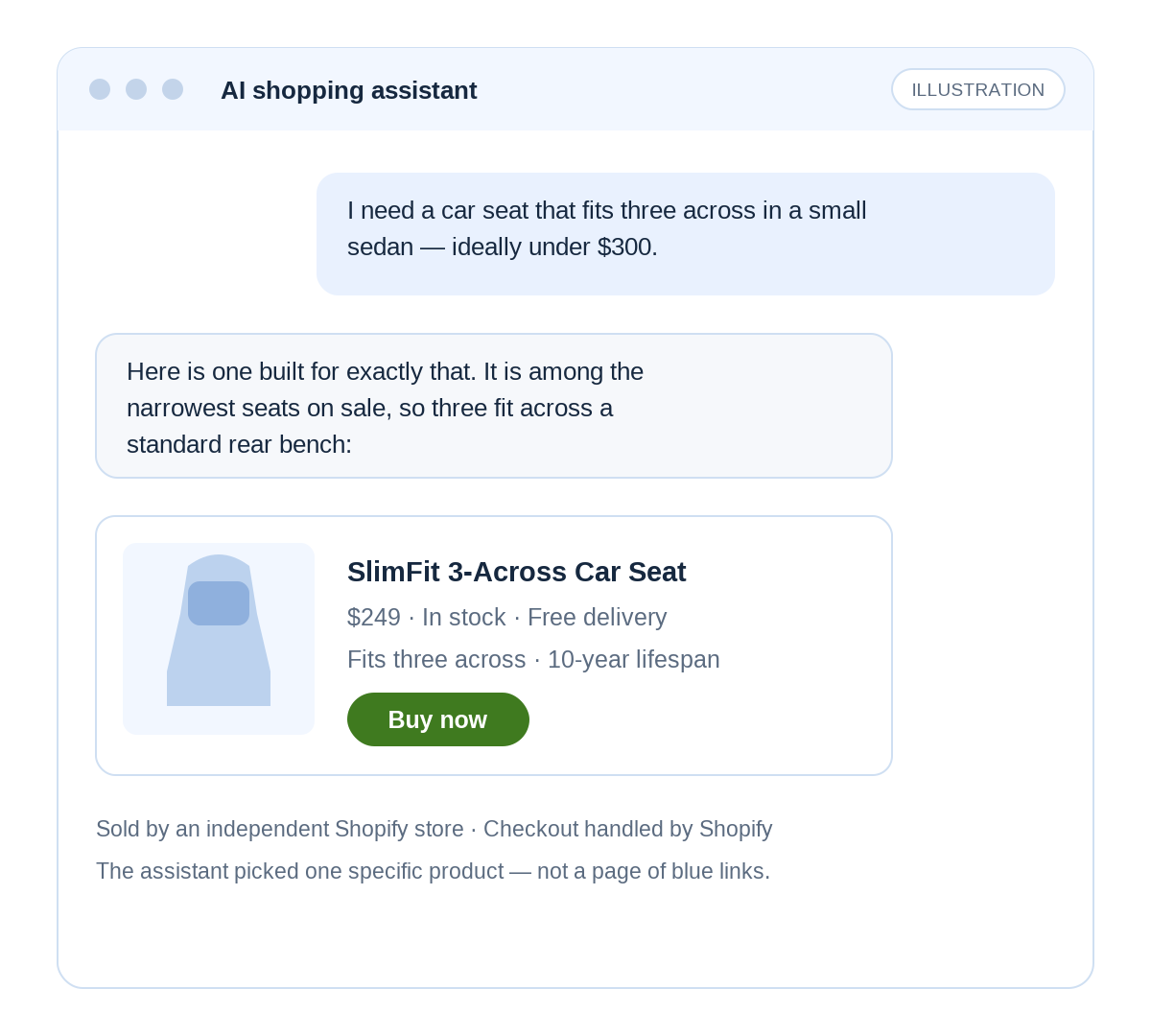
An Agentic Storefront is the merchant’s side of that arrangement. It is a sales channel in your Shopify admin that connects your products to the AI platforms, using Shopify Catalog as the shared data layer. Catalog takes what it finds in your store — titles, descriptions, images, prices, inventory, shipping — structures it into a standard taxonomy, verifies price and stock in real time, and syndicates it to every connected AI channel automatically. Change a price in your admin and the change follows your products into the chats. Underneath, the transactions run on shared plumbing: the Universal Commerce Protocol, an open standard co-developed by Shopify and Google, is what lets an assistant build a cart and check out against your store’s actual rules instead of a screenshot of them.
Shopify announced Agentic Storefronts with its Winter ’26 Edition and switched them on for eligible stores in March 2026. In October 2026 it widened the door further, letting shoppers connect their own AI agents through the Shop app. The direction of travel is not subtle: the storefront is being unbundled from the website.
How it works, in four unglamorous steps
1. Your data flows into Catalog. Eligible products are listed in Shopify Catalog by default. There is nothing to configure and no feed to maintain; Catalog cleans and structures what your store already publishes, and can infer extra attributes from purchase patterns — Shopify’s example is a candle filed under home decor being recognised as a popular Mother’s Day gift.
2. The assistant does the shortlisting. Asked a question, the AI searches Catalog and ranks what it finds. Shopify lists the ranking ingredients plainly: data quality, relevance, availability, pricing and engagement signals. Note the first one. It is the only one entirely within your control.
3. The purchase happens in one of two places. In ChatGPT, the buyer is handed to your own store’s checkout in an in-app browser. In Copilot and Google’s channels, checkout can be completed inside the chat itself, where you have direct checkout enabled. Either way Shopify handles payment processing, tax and fraud checks.
4. The order lands in your admin, labelled. You remain the merchant of record — the customer relationship and the data stay yours — and the order arrives with attribution showing which AI channel drove it. Your admin reports sales, orders, sessions and conversion per channel, so this is measurable rather than a matter of faith.
What the shopper actually sees
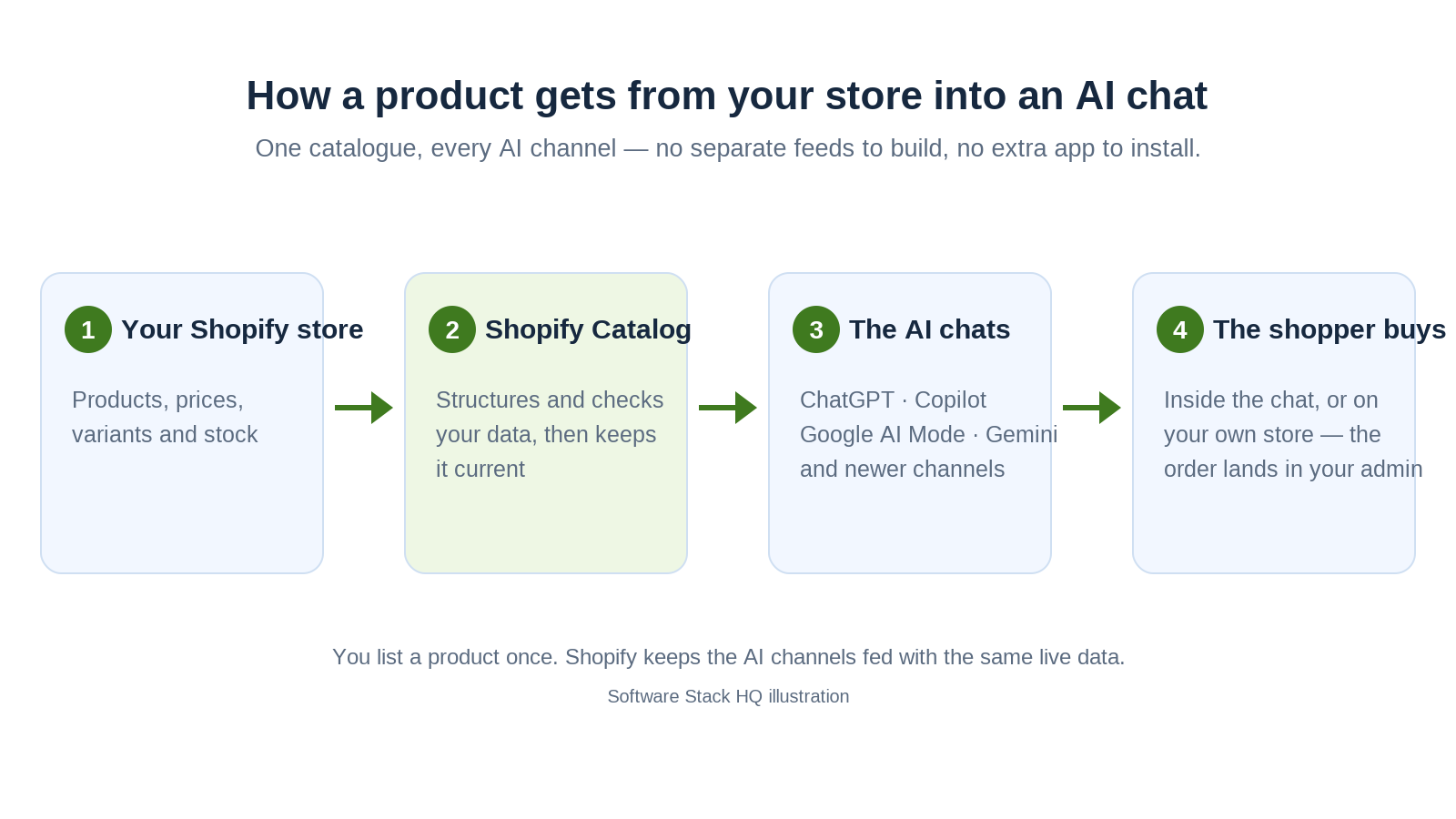
Not a search results page. The assistant answers with a small number of specific products, each with price, availability and a route to buy, and it can reason across several constraints at once in a way keyword search never could. Shopify president Harley Finkelstein’s own example, from the company’s earnings call, was a shopper looking for a car seat that fits three across a sedan — a request that is really four requests wearing a trench coat: the product, the width, the car, the fit. Keyword search hears “car seat”. The assistant hears the whole sentence.
Shopify reports that half of AI-referred sessions land directly on a product page — two and a half times the rate of traditional search. That is the behavioural signature of the channel: the browsing happened in the chat, so the click, when it comes, is close to a decision. The store visit is no longer the start of the funnel. Increasingly, it is the end of it.
Why this is landing on small stores, not just big brands
The obvious fear was that AI shopping would become a winner-takes-all machine for famous brands — the assistant recommends what it has heard of, and it has heard of Nike. Shopify’s numbers point the other way. On the company’s Q2 2026 earnings call, Finkelstein reported that traffic and orders referred from AI platforms to Shopify stores had each roughly tripled year over year — and that 75% of AI-attributed purchases came from product categories outside Shopify’s top 100. The long tail, in other words, is where the AI money is going: reef-safe sunscreen that leaves no white residue, the car seat that fits three across. Precisely specified needs favour precisely described products, and small specialists describe their products very precisely indeed.
There is a second, quieter reason the independents are competitive here. The assistant’s answer is assembled from structured catalogue data and from the wider web’s stock of reviews, comparisons and buying guides — the unglamorous editorial layer that explains which product suits which job. Shopify and its app ecosystem are leading this shift partly on technology, but partly because that layer already exists at scale around the platform: millions of stores, a common catalogue, and a decade of content teaching buyers how to choose. A niche merchant on Shopify is plugged into both. A niche merchant on a bespoke platform, however lovely, is waiting for the assistants to come and scrape them — with whatever price was on the page in March.
What it costs: nothing extra, with one honest asterisk
Shopify’s wording is unusually plain for a platform announcement: Agentic Storefronts carries no transaction fees beyond standard processing rates, and its FAQ adds “no additional fees”. The AI channels are bundled into the plans rather than sold as an add-on — the same pattern we found across the current pricing page, where “sell in AI chats” now sits in the standard feature list. What a sale through an AI chat costs you, then, is what any sale costs you: the plan, the card rate, and whatever apps you run. We priced that whole stack, with worked totals, in our guide to how much Shopify costs.
The asterisk is not a fee; it is geography. Purchasing through AI channels is currently available to US buyers only. ChatGPT and Copilot are live for any Catalog merchant who sells to US buyers, wherever the store is based; Google’s AI Mode and Gemini started with select US-based brands and are still rolling out. If your customers are in Leeds rather than Louisville, your products can be building a presence in the catalogue today, but the tills on those channels are not open to them yet. Shopify’s line — when the partners expand, its merchants “will be ready by default” — is at least a coherent reason to tidy the data now.
What to do about it: the five-minute admin check
You cannot buy a better ranking, and Shopify offers no lever labelled “appear more”. What you can do is remove the reasons an assistant might skip you. Start with the settings: in Sales channels → Agentic, the default “Allow Shopify to manage for me” gives every current channel access to your products, activates direct checkout where supported, and enrols you in future channels automatically. Leave it on unless you have a specific reason to fence a channel off; if you do switch to manual control, the same screen lets you manage Catalog access per channel and direct checkout per channel.
Then look at your products the way the machine reads them. The Agentic section includes a search preview tool — run your own best queries and see whether your products surface — and a Listing quality indicator for each product, scored on the signals in the table below. This is Shopify telling you, in its own interface, what the assistants grade. It is the closest thing to an answer key this channel has published.
| Listing quality signal | What Shopify measures | What to do |
|---|---|---|
| Description completeness | The depth of your product description — AI channels match products to natural-language questions from it | Write descriptions that answer the real questions: who it suits, what it fits, what it is made of. Shopify’s Sidekick can help you expand a thin one |
| Image coverage | How many product images you provide | Add the extra angles and in-use shots. Assistants use images to represent your product in contexts you do not control |
| Product reviews | Your average rating and review count, from verified sources | Collect reviews properly and keep collecting them. Trust signals travel with the product into the chat |
| Variant & option completeness | Whether sizes, colours and options are complete, in stock, and named understandably | Spell variant names out. An option called “BLK/L” is a shrug to a machine; “Black, large” is an answer |
| Shop policy completeness | Whether shipping, returns and refund policies are present | Publish the policies. An assistant recommending a store with no returns policy is sticking its neck out, and it knows it |
Signals as listed in Shopify’s Help Center for the Agentic listing quality indicator, checked 23 October 2026.
The honest limits
Four, so nobody oversells this — including us. First, scale. Tripled is a growth rate, not a volume: AI channels are still a small slice of total commerce next to search and social, and Shopify’s own framing is that AI is adding to traditional search rather than replacing it. Sack your SEO and you will regret it by Christmas.
Second, the black box. Your admin reports tell you which channel sold and how each is performing, and the search preview shows raw Catalog results. What neither shows is the assistant’s reasoning — why your product was picked over a rival’s, in the model’s own words. You can improve the inputs. You cannot inspect the judgement.
Third, opt-outs are slower than opt-ins. Removing Catalog access can take up to seven days to stop your data being shared, and your products remain findable through ordinary web crawling regardless — the settings govern the catalogue pipe, not the entire internet’s memory of your store. Shop, Shopify’s own app, sits outside the off-switch entirely.
Fourth, readiness is uneven. Channel availability varies by partner, by rollout stage and, above all, by buyer country. Treat any dashboard claim about “AI sales” with the same suspicion you would apply to a single month’s analytics: directionally interesting, not yet a strategy.
Bottom line
Agentic Storefronts is best understood as a change of venue. The shopfront is moving into the conversation, and Shopify — having spent twenty years building the checkout, the catalogue and the merchant base — has positioned itself as the landlord of the new venue. For a merchant, the deal on offer is genuinely unusual: distribution into the fastest-growing discovery channel in commerce, switched on by default, at no extra fee, in exchange for nothing more exotic than accurate product data.
The work, such as it is, is a tidy-up: check the settings, fatten the descriptions, name the variants like a human, publish the policies, and use the preview tool to see yourself as the machines see you. Do it once and every future channel Shopify enrols you in inherits the improvement. Then go back to running the shop — the assistants will handle the introductions. Our full Shopify review covers the platform itself; this page is about where it is now selling.
Agentic Storefronts: FAQs
What is a Shopify Agentic Storefront?
It is a sales channel inside Shopify that connects your products to AI shopping platforms through Shopify Catalog. Instead of a shopper visiting your store, an AI assistant can surface your product inside a conversation, answer questions about it and — depending on the channel — complete the purchase there. You remain the merchant of record and the order arrives in your Shopify admin like any other.
Do I need to install or set anything up?
No. Shopify says Agentic Storefronts is automatically activated for eligible merchants, with no apps to install and no custom integration. Your products are syndicated through Shopify Catalog by default. The settings exist so you can manage the channels, not so you can switch the thing on.
Does Shopify charge extra for sales through AI channels?
Shopify states there are no transaction fees beyond standard processing rates for Agentic Storefronts sales, and its FAQ says there are no additional fees. Your normal plan and payment rates apply, exactly as they would for a sale on your own storefront.
Which AI platforms can sell my products?
Shopify lists ChatGPT, Microsoft Copilot, AI Mode in Google Search and the Gemini app, and its admin also carries channel controls for Meta. Availability is not uniform: ChatGPT and Copilot are live for merchants in Shopify Catalog who sell to US buyers, while AI Mode and Gemini began with select brands and are rolling out more widely. Purchasing through AI channels is currently available to US buyers only.
Where does the customer check out?
It depends on the channel. In ChatGPT, the buyer finishes the purchase on your own online store through an in-app browser. In Microsoft Copilot and Google’s channels, checkout can be completed inside the AI interface where you have direct checkout enabled. Either way, Shopify processes the transaction and the order lands in your admin with the AI channel credited.
Can I turn it off, or choose my channels?
Yes. In Sales channels → Agentic, turn off “Allow Shopify to manage for me” to manage things manually: you can remove Shopify Catalog access altogether or per channel, stop automatic enrolment in future channels, and toggle direct checkout where it is offered. Two caveats: removing Catalog access can take up to seven days to stop data sharing, and it does not remove your products from Shopify’s own Shop app — hiding a product from every agentic surface means setting it to Unlisted, which also hides it from search engines.
I don’t sell on Shopify. Can I still appear in AI chats?
That is what Shopify’s Agentic plan is for. Brands running on other platforms can add products to Shopify Catalog and be syndicated across the AI channels without moving their store. There is no monthly subscription; you pay standard payment rates when sales run through Shopify Checkout.
Sources and editorial notes
This page is an editorial desk-research explainer, not a hands-on product test. Feature behaviour, channel availability and settings were checked against Shopify’s own agentic commerce guide and Help Center on 23 October 2026; the growth figures are from Shopify’s Q2 2026 earnings call as reported by CNBC and the Motley Fool. AI channel availability is changing quickly and varies by country — the settings shown in your own Shopify admin govern your store.