
AI chatbots: the quick facts
The short version: start free, then buy the agent your questions deserve
Most stores should start with Shopify Inbox, because it is free, built in, and answers the policy questions that dominate early chat. When the questions outgrow it, the market splits by temperament: Tidio is the chat-first platform whose Lyro AI agent answers from your own content across chat, email and social; Gorgias is the ecommerce helpdesk whose AI Agent does not just answer but acts — editing, cancelling and refunding orders inside the ticket; Intercom is the generalist support platform whose Fin agent is excellent and priced like it. Every price below was checked against the vendors’ own pages and App Store listings on 23 October 2026. The trap in all of them is the same: the AI is metered separately from the plan, so the honest comparison is cost per resolved conversation — which is why we work two bills in full below.
First, untangle the phrase: three products, one name
“AI chatbot” is doing at least three jobs in the marketing, and stores buy the wrong one when they do not separate them. Instant answers are set replies to set questions — your delivery times, your returns window — triggered inside a chat widget. Cheap, predictable, and genuinely sufficient for a young store. AI agents are the newer species: they read your help content, policies and store data, answer unforeseen questions in their own words, look up the customer's order, and hand over to a human with the conversation attached when they reach their limit. Agent-assist tools help the human instead — suggesting replies, summarising threads — without ever facing the customer.
One clarification that saves real confusion: Shopify Sidekick is not a customer chatbot. Sidekick is Shopify's AI assistant for you, inside the admin — reporting, drafting, building. Shopify Magic likewise writes your product descriptions. Neither talks to shoppers. The built-in that faces your customers is Inbox, and it is Inbox that belongs in this comparison. Vendors blur these categories on purpose; the blur is where the budget goes.
Shopify Inbox: the free baseline
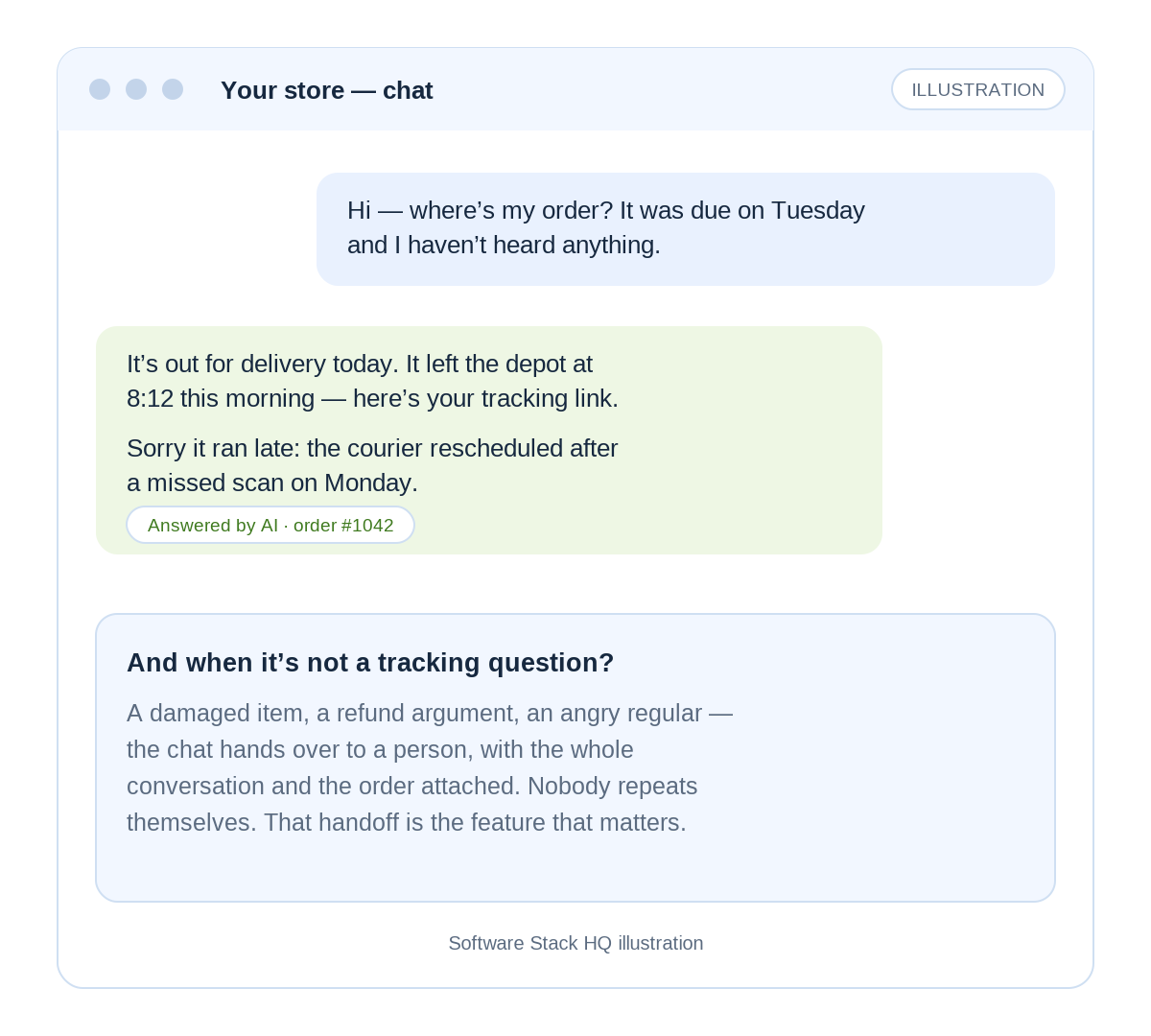
Inbox puts a chat widget on your storefront and a conversation list in your admin, with the customer's profile, browsing, cart and order history beside each chat — context most paid tools charge to assemble. Its AI layer has two parts: instant answers and suggested replies for the recurring questions, and an opt-in Inbox agent that can look up orders and answer policy questions on its own inside the widget. It costs nothing, on every plan, for ever.
Its limits are structural, not accidental. Inbox is one channel — your storefront chat. Email, Instagram, Messenger and SMS live elsewhere, answered elsewhere, by you, in another tab. Reporting is basic, and the agent's world ends at the widget's edge. None of that matters until the day support becomes a job rather than an interruption — which is exactly the day the next two products start earning their invoices.
Tidio and Lyro: the chat-first AI agent
Tidio folds live chat, email, Messenger, Instagram and WhatsApp into one inbox, with rule-based Flows for set tasks and Lyro, its AI agent, for everything else. Lyro trains on your website content, help articles and FAQ pairs, runs on Anthropic's Claude alongside Tidio's own models, and — through the Shopify integration — can check order status, recommend products from live stock and perform order actions from inside the chat. Tidio says Lyro resolves up to 67% of customer questions on its own; treat that as a vendor's ceiling rather than a promise, and note the one hard number in the range: the Premium tier carries a guaranteed 50% resolution rate, which is what confidence looks like when it is contractual.
Pricing is modular, which is both the appeal and the homework. The free plan covers 50 billable conversations a month and a one-off taste of 50 Lyro conversations. Starter is $29 a month ($24.17 billed yearly) for 100 conversations; Growth runs from $59 as conversation volume rises; and Lyro itself is an add-on from $39 a month for 50 AI conversations, scaling by quota from there. A small store running chat plus a modest Lyro quota is realistically at $68 a month — reasonable for an employee who works every hour of it, provided your questions are the kind it can answer. Feed it a thin FAQ and you have bought a very polite way of saying “I don't know” at scale.
Gorgias: the helpdesk whose AI can act
4.3 out of 5 on the Shopify App Store (706 reviews) · Recommended by Software Stack HQ — our pick for established stores running serious support volume, where the helpdesk has to fix orders, not just answer questions.
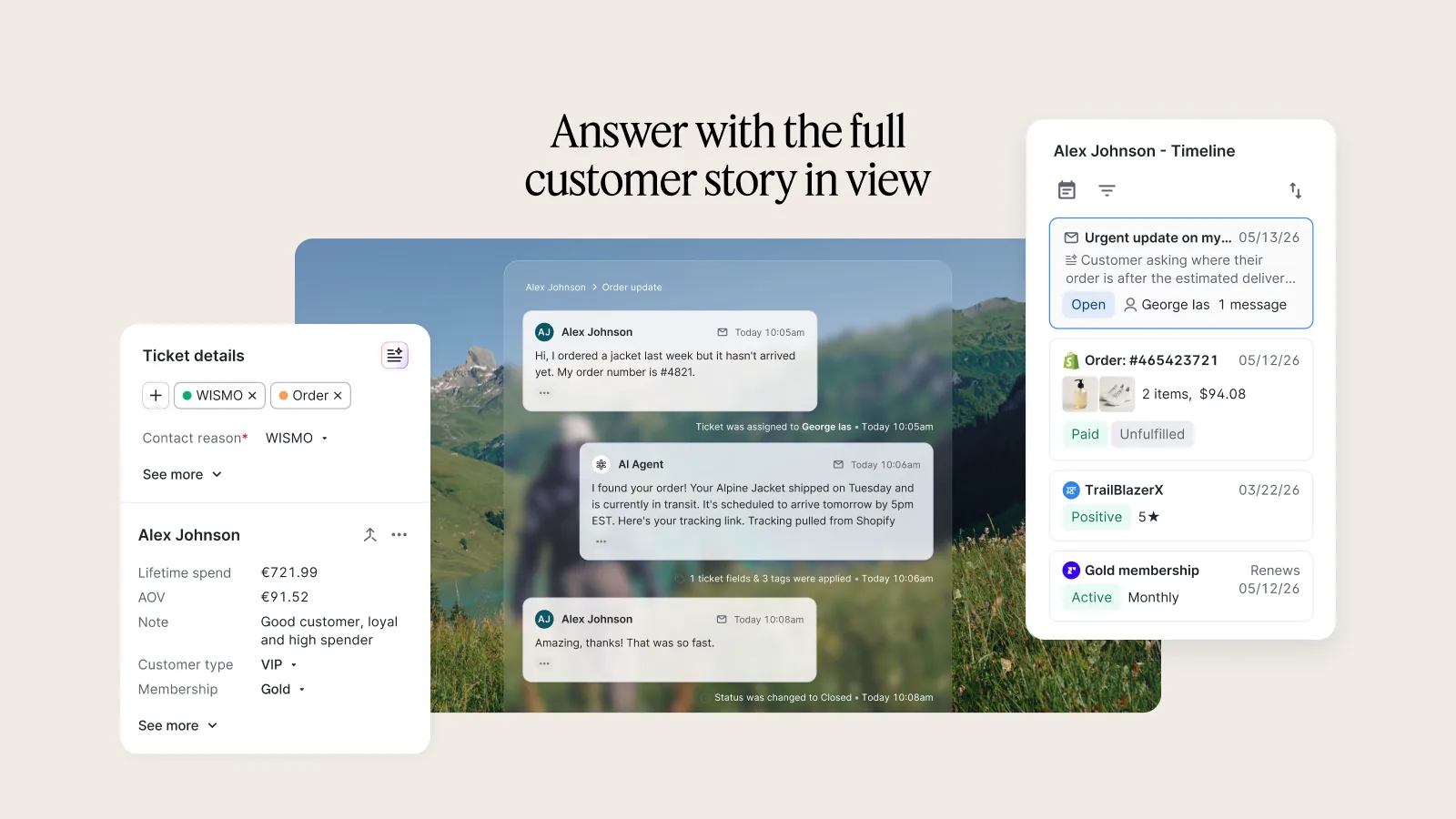
Gorgias is built the other way up: a full helpdesk first — email, chat, social, SMS and voice in one inbox, with the customer’s Shopify orders, history and data inside every ticket — and AI laid through it. Its AI Agent resolves questions end to end and, through Actions you control, can edit, cancel or partially refund an order without a human opening Shopify. A separate AI Shopping Assistant answers product questions and recommends in real time, which makes Gorgias the one product here that treats support chat as a sales channel as well as a cost centre.
The pricing model is tickets, not seats: Starter $10 a month for 50 tickets (three agents), Basic $60 for 300, Pro $360 for 2,000, Advanced $900 for 5,000, with annual billing taking roughly a sixth off. Then the meter that matters: each automated interaction costs $0.90 on annual billing, $1.00 monthly — and an AI-resolved conversation also counts against your ticket allowance. That stacking is the honest caveat on an otherwise strong product: at volume, the AI line can outgrow the plan line, and peak season will test both. Model November, not March.
Intercom (and a word on Zendesk): the generalists
Intercom was built for support teams generally, and its AI agent, Fin, is the polished end of the category: it answers across chat, email and more, from your help content and connected data, and charges $0.99 per outcome — a resolution, on top of seat plans that start at $29 per seat a month billed yearly for Essential. For a support organisation, that maths can be excellent. For a single Shopify store, you are buying a platform whose centre of gravity is elsewhere: the Shopify connection is an integration, not the home turf, and per-seat pricing punishes the seasonal help every store hires in December.
Zendesk deserves its one line: Suite plans from $55 per agent a month billed yearly, formidable reporting, AI billed per resolution on top — the right answer for a large, multi-brand support operation, and more machinery than a storefront needs. If your support team has its own manager, you have outgrown this page. Congratulations, and condolences.
The four, side by side
| Option | What it is | Starts at | How the AI is billed | Best for |
|---|---|---|---|---|
| Shopify Inbox | Built-in storefront chat with instant answers and an AI agent | Free | Included | New stores; questions still occasional |
| Tidio + Lyro | Chat-first platform; Lyro AI agent across chat, email and social | Free plan; Starter $29/mo | Lyro add-on from $39/mo per 50 AI conversations | Small teams whose support arrives by chat |
| Gorgias | Ecommerce helpdesk; AI Agent with order Actions | $10/mo (50 tickets) | $0.90–$1.00 per automated interaction, plus the ticket | Email-heavy stores; support that must fix orders |
| Intercom + Fin | Generalist support platform; Fin AI agent | $29 per seat/mo | $0.99 per Fin outcome, on top of seats | Support teams serving more than one product or brand |
Plans and AI rates checked 23 October 2026 against vendor pricing pages and App Store listings. Zendesk Suite, for scale, starts at $55 per agent/month billed yearly with AI billed per resolution.
The bill, worked: two honest examples
A chat-led store on Tidio. Starter at $29 a month covers the inbox and 100 human-handled conversations; add Lyro at $39 for 50 AI conversations and the month costs $68, with the AI absorbing the tracking-and-returns traffic that used to interrupt your evenings. Grow the AI quota and the bill grows by conversations, in the open.
An email-heavy store on Gorgias. Basic at $60 a month covers 300 tickets. Say the AI Agent fully resolves 150 conversations: at the monthly-billing rate of $1.00 each, that is $150 of AI fees — and those 150 resolutions also consume 150 of the 300 tickets. Total $210 for the month, before any overage. Neither number is a scandal; both are invisible if you only read the plan card. This is why the per-resolution rate, not the plan price, is the comparison that matters — and why a store should pilot on its real questions for a month before committing to a tier.
What none of them can do
None of these tools can answer a question your store has never answered anywhere. The agent reads your policies, your FAQs and your product data; where those are silent, it improvises or escalates, and improvisation in your brand's voice is still improvisation. None of them can rescue a bad policy — a returns process customers hate will now be explained to them instantly, at 2am, with perfect grammar. And none of them replaces the human for the conversations that carry the business: the damaged heirloom, the furious regular, the wholesale enquiry hiding inside a complaint. The correct ambition for AI support is narrower and better than replacement: every routine question answered in seconds, every human hour reserved for the questions that deserve one.
Bottom line
Start on Inbox because it is free and already yours. Move to Tidio when chat and social become the front door and you want an agent answering the repetitive half of it. Move to Gorgias when support means email volume and order surgery, and you want one system — AI included — that can finish the job inside the ticket. Keep Intercom in mind for the day support outgrows the store. Whichever you choose, choose it on a month of your real questions, transcripts open, per-resolution maths done — the vendors all offer trials or free tiers, and an AI chatbot, like a shop assistant, should be hired on a trial shift, not a brochure. The chat decision also sits inside the wider stack in our beginner apps guide.
AI chatbots for Shopify: FAQs
Is Shopify Inbox enough for a small store?
Often, yes. Inbox is free, lives inside your admin, shows the customer's cart and order history beside the chat, and its instant answers plus suggested replies handle the policy questions that make up most early chat. Its limits are reach and depth: it is chat on your own storefront only — no email, SMS or social in the same inbox — and its AI agent works inside that one widget. Outgrow those limits before you outgrow Inbox.
What does an AI chatbot really cost per month?
More than the plan card, because the AI is metered separately almost everywhere. On Tidio, Starter ($29/mo) plus the Lyro add-on (from $39/mo for 50 AI conversations) is $68 a month before you have answered anything at volume. On Gorgias, the helpdesk is priced by tickets — Basic is $60/mo — and each conversation the AI Agent resolves adds $0.90–$1.00 and consumes a ticket as well. Model your busiest month, not your average one.
Can these AIs actually refund or change an order?
The helpdesk-grade ones can, inside limits you set. Gorgias's AI Agent takes Actions — editing, cancelling or partially refunding an order — and Tidio's Shopify integration performs order actions such as refunds and edits from the chat. Shopify Inbox's agent looks orders up and answers policy questions; it does not operate on them. Decide which powers you are handing over before you hand them over, and start with order-status answers before refunds.
Will the AI make things up?
It will answer from what you give it: these agents ground their replies in your help content, policies and store data, and a gap in that material is where confident nonsense breeds. The discipline is unglamorous — write the policy pages properly, feed the agent your real FAQs, read its transcripts weekly for the first month, and correct the source document, not just the answer. An AI agent is a very fast reader of your own documentation; it cannot rescue documentation that does not exist.
Which one should a small store start with?
Inbox, because it is free and already installed, until one of two things happens: questions start arriving on email and social as much as chat (time for a shared inbox — Tidio or Gorgias), or the same ten questions eat your evenings (time for an AI agent — Lyro for a chat-led store, Gorgias's Agent when support is email-heavy and order fixes are the work). Intercom enters the conversation when support is a multi-team function, not a store job.
Do they work in languages other than English?
Tidio's App Store listing covers English, German, French, Italian, Portuguese (Brazil) and Spanish, and Lyro answers in the shopper's language where the content supports it. Gorgias's listing is English-first. Whichever you choose, the honest answer is that the AI is only as multilingual as the help content you feed it — machine-translated policies produce machine-quality answers.
Sources and editorial notes
This page is an editorial desk-research comparison, not a hands-on test. Capabilities and prices were checked against the vendors’ own pages and App Store listings on 23 October 2026. Resolution percentages quoted are the vendors’ own figures and are labelled as such; the Gorgias links are approved referral links and the Tidio links are ordinary links, and neither arrangement changes the order or the verdicts, which follow the fit for a Shopify store. AI pricing models in this category change often — confirm the current rates before committing.
- Shopify App Store — Shopify Inbox ↗
- Tidio — FAQ (Lyro resolution rates, pricing) ↗
- Shopify App Store — Tidio live chat & AI chatbot ↗
- Shopify App Store — Gorgias: AI, Helpdesk & Chat ↗
- Gorgias pricing breakdown — plan and AI Agent rates cross-checked ↗
- Intercom Fin pricing — read from Intercom's pricing page ↗
- Best Shopify apps for beginners — Software Stack HQ ↗
- Shopify review — Software Stack HQ ↗