
AI recommendations: the quick facts
The short version: be the easiest product to describe accurately
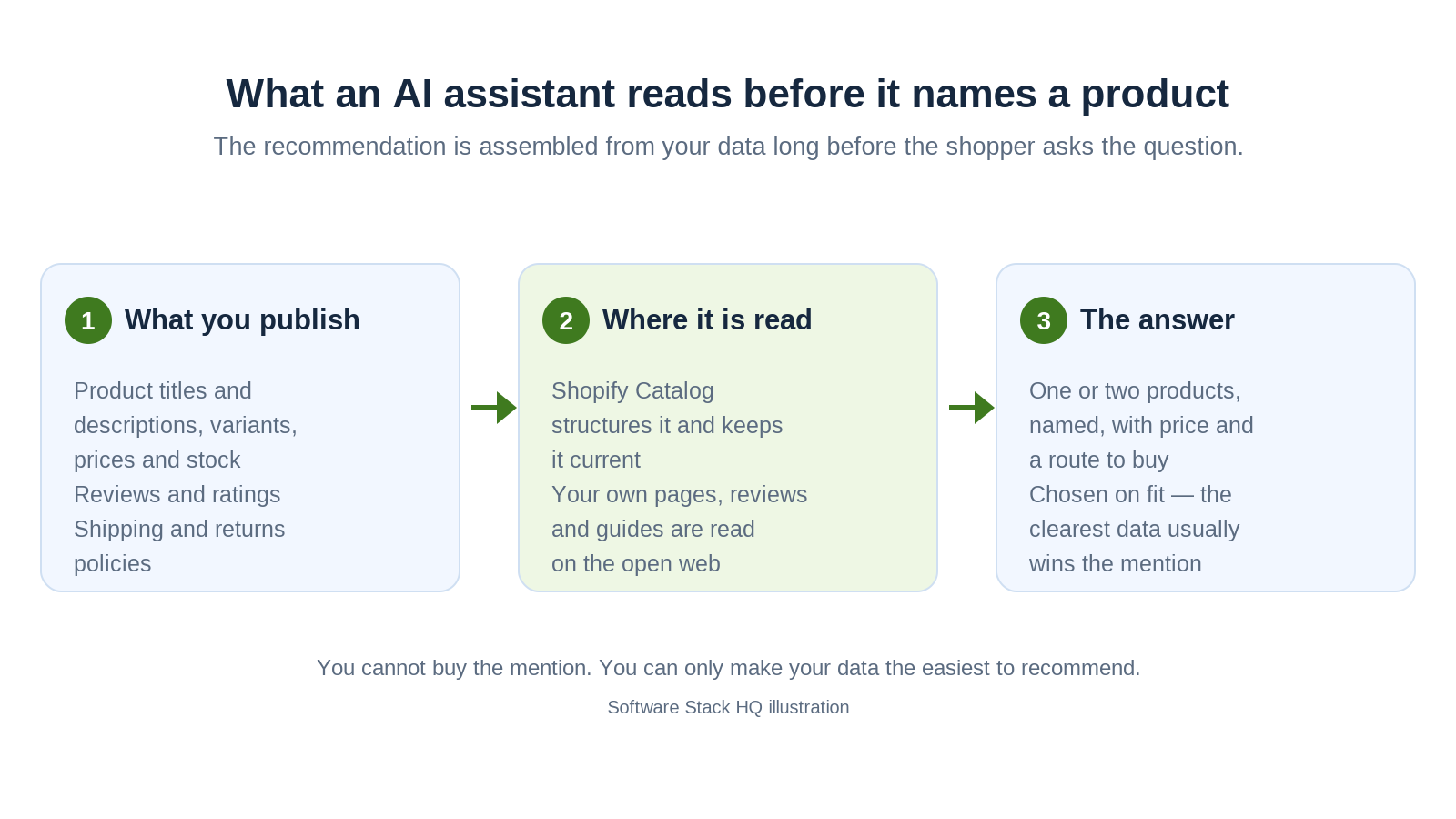
An AI assistant recommending a product is doing something very specific: it is defending a choice, in words, to a person who asked a detailed question. It reaches for products it can describe precisely — what they are, who they suit, what they cost, whether they are in stock, what happens if they come back. Your job is to be describable. On Shopify, most of that material flows to the assistants through Shopify Catalog, the structured database behind Agentic Storefronts, which is already switched on for eligible stores. The rest is read from the open web: your product pages, your reviews, your policies and the guides that compare your kind of product. There is no application form and no fee. There is, however, homework — and Shopify has published the marking scheme.
Two doors into the same answer
Your products can enter an AI conversation through two doors, and it is worth keeping them separate in your mind, because you maintain them differently.
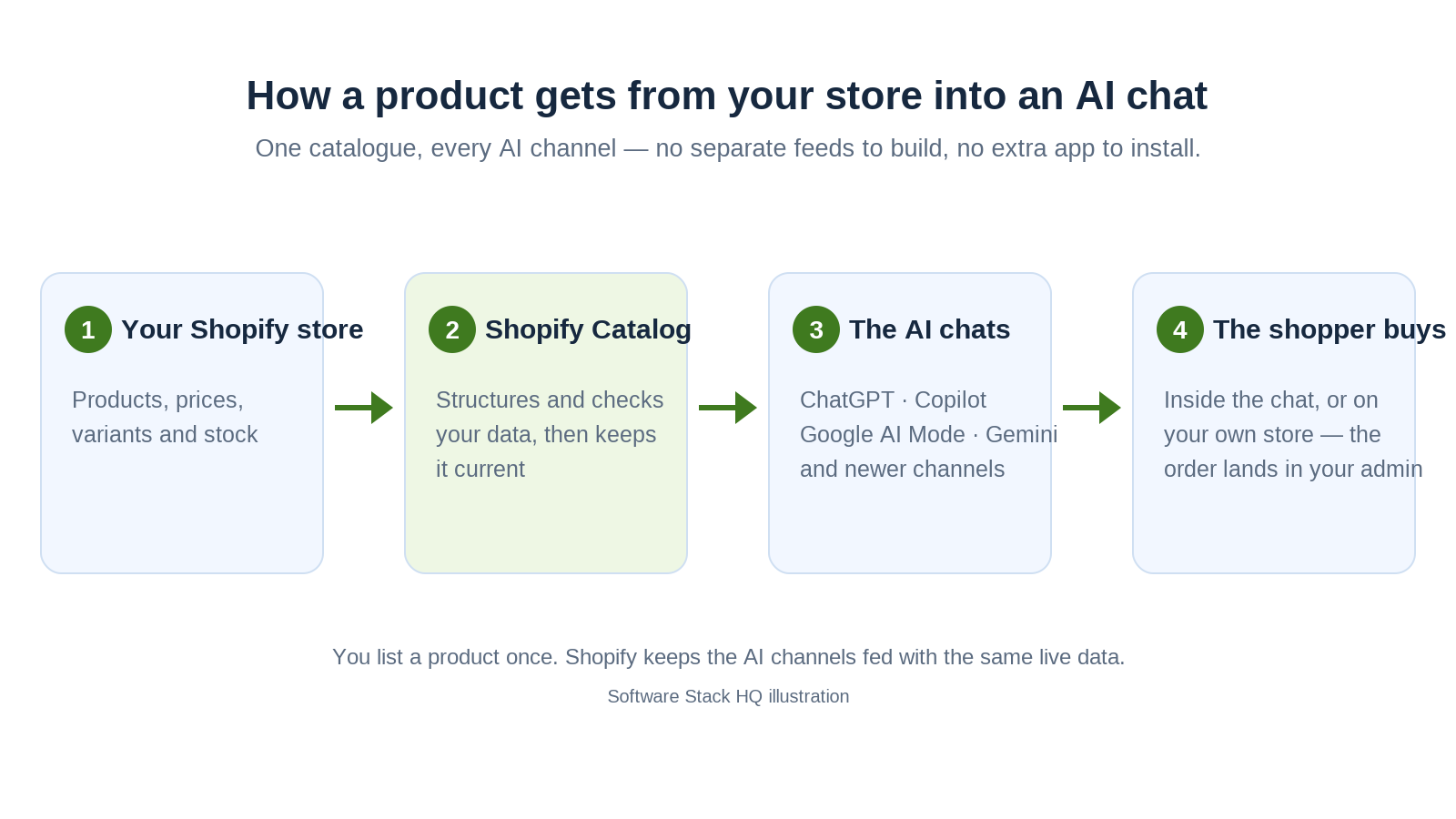
Door one is the catalogue. Shopify Catalog takes your store's data — titles, descriptions, images, prices, inventory, shipping — structures it against a standard taxonomy, verifies price and stock in real time, and syndicates it to ChatGPT, Microsoft Copilot, Google AI Mode, the Gemini app and other channels as they arrive. This door is automatic. You do not build a feed for it; you keep your store data honest and Catalog carries it.
Door two is the open web. Assistants also read and cite the wider internet: your own product and collection pages, review platforms, comparison sites and buying guides — the editorial layer that explains which product suits which job. Shopify lists engagement signals among the ingredients its ranking draws on, which is a platform's polite way of saying the web's opinion of your products is an input, not a decoration. A store with clean catalogue data and a thin web presence is half-dressed. So is the reverse.
The marking scheme: Shopify's five listing-quality signals
Inside Sales channels → Agentic, Shopify shows a Listing quality indicator per product — the platform grading your products on the signals its own Help Center lists. This is as close to an answer key as AI commerce has published, and it deserves to be treated as one. None of the five is exotic. All five are within a small store's reach in an afternoon each.
| Signal | What is actually being graded | The fix that moves it |
|---|---|---|
| Description completeness | Whether your description has the depth to answer natural-language questions — who it suits, what it fits, materials, dimensions, care | Rewrite thin descriptions to answer real questions in plain sentences. One honest paragraph beats six bullet points of adjectives |
| Image coverage | How many images you provide, across angles and uses | Add the in-use shot and the scale shot. Assistants represent your product in contexts you do not control; give them material |
| Product reviews | Your average rating and review count from verified sources | Collect reviews systematically (see below). A 4.6 from 200 buyers out-argues a 5.0 from three |
| Variant & option completeness | Whether sizes, colours and options are complete, in stock and understandably named | Spell names out: “Black, large”. Retire out-of-stock variants instead of leaving ghosts in the list |
| Shop policy completeness | Whether shipping, returns and refund policies are present on the store | Publish specific policies — timescales, costs, who pays return postage. Vague policies read as risk |
Signals as listed in Shopify’s Help Center for the Agentic listing quality indicator, checked 23 October 2026.
Write product pages for a reader who quotes you
The catalogue door is fed from your product pages, so write them for two readers at once: the human skimming, and the machine deciding whether it can safely quote you. The habits are the same habits good stores have always had, with the tolerance for vagueness removed.
Titles that say what the thing is. “Aria” is a name, not a description. “Aria insulated steel bottle, 750ml, leakproof” is a product an assistant can match to “a bottle that keeps coffee hot on a train”. Keep the poetry for the brand page; the title is a label on a shelf the machine is reading in the dark.
Descriptions that answer. The questions shoppers ask assistants are the questions they used to type into your FAQ page: does it fit, what is it made of, how do I clean it, what does it not do. Write those answers into the description itself. Shopify's own Sidekick can expand a thin description — useful, provided you then read it like a stranger and cut anything it invented.
Structured data, checked once. Shopify themes output product structured data — the machine-readable layer carrying price, availability and review ratings — as part of the page. You do not need to write it; you need to confirm it survives your theme and your apps. View the page source or run the URL through a rich-results test, and check the price and stock it reports are the true ones. A catalogue is only as honest as its worst feed.
Reviews: the evidence file
When two products fit a question equally well, the assistant — like the human — reaches for the one other people have vouched for. Shopify's grading says so outright: product reviews, meaning rating and count from verified sources, are one of the five signals. Reviews also work the second door: they are the web's most-quoted evidence about whether a product does what it claims.
So collect them properly. Ask every buyer, automatically, a sensible interval after delivery; make leaving one take under a minute; import the reviews you already have elsewhere rather than starting from zero. A reviews app earns its keep here — Judge.me's free plan, for instance, covers unlimited product reviews and feeds Google rich snippets, which is why it sits in our beginner stack. What never to do: buy reviews, seed them, or gate the unhappy ones out. Assistants aggregate across sources; a wall of five stars on your site and a trail of complaints everywhere else is not a disguise, it is a discrepancy.
Policies are data too
The least glamorous signal on Shopify's list is the one stores most often leave blank. Shop policy completeness is graded because an assistant recommending a store with no stated returns policy is spending its own credibility: if the shoes do not fit, what happens next is part of the recommendation. Publish the policies, and make them specific — delivery timescales by region, the returns window in days, who pays return postage, how refunds are issued. “We want you to be happy” is a sentiment. “Returns within 30 days, free in the UK” is a fact an assistant can repeat. Machines, like customers, repeat facts and discount sentiments.
The content door: be worth citing
Door two rewards a different kind of work. Assistants assembling an answer lean on the web's explanatory layer — comparisons, buying guides, “best X for Y” roundups, detailed reviews — because that is where the reasoning lives. Your products enter those answers by being in the conversation those pages are having.
What you control: your own guides and comparison content, written honestly enough to be quoted (a sizing guide that admits which build your boot does not suit will out-cite a brochure); accurate listings wherever your products are already reviewed or compared; and the basics of being findable — crawlable pages, sensible titles, the same structured-data hygiene as your product pages. What you do not control: whether a given roundup includes you. Earn it the slow way, by being the product in your niche whose facts are easiest to check. Editors and algorithms, for once, want the same thing.
The first 30 days: a checklist that fits a small store
Four weeks, one theme each, in the order the assistants read you. Nothing here needs a developer, an agency or a new app you have not already met on this page.
| Week | Focus | Done when |
|---|---|---|
| Week 1 | Settings and policies | Agentic settings checked in Sales channels → Agentic; shipping, returns and refund policies published and specific |
| Week 2 | Descriptions and variants | Your top ten products rewritten to answer real questions; every variant spelled out in full; dead variants retired |
| Week 3 | Images and reviews | Missing angles and in-use shots added; review collection switched on for every order; existing reviews imported |
| Week 4 | Test and tidy | Your own best queries run through the Agentic search preview and an AI chat; the gaps you find fixed; structured data spot-checked on five product pages |
Then stop, and let it compound. Re-run week 4 monthly. The stores that win this channel will not be the ones who found a trick; they will be the ones whose data was already tidy when the shoppers arrived — and who kept it tidy while everyone else was looking for the trick.
What will not work
A short dishonour roll, to save you the invoices. Guaranteed-placement services: there is no placement to guarantee; the channel does not sell one. Keyword stuffing: assistants match meaning, not repetition, and a description padded with phrases reads worse to the human who lands on it. Fake or bought reviews: detectable, against platform rules, and a bonfire of the one asset — trust — the whole exercise is building. Hiding the price or the policies: missing data is not mystery, it is disqualification. And abandoning your Google presence because a shinier channel arrived: the assistants were trained on the web Google indexes, and your search traffic pays this month's bills. AI visibility is an addition to a well-run store, not a replacement for one.
Bottom line
Getting recommended by ChatGPT turns out to be disappointingly un-magical: it is the reward for describing your products completely, pricing them clearly, stocking them honestly, reviewing them publicly and writing your policies down — the disciplines of a well-run shop, finally marked by a machine that reads everything. Shopify has built the pipe (our Agentic Storefronts explainer covers how it works) and published the marking scheme in your own admin. The stores being named in AI answers a year from now are, in most cases, the ones who did this month's homework while their competitors were still asking whether it was real. It is real. The homework is above.
Getting recommended by AI: FAQs
Can I pay to get my products recommended by ChatGPT?
No. There is no sponsored slot in Shopify Catalog and no advertising product that buys a recommendation inside these AI answers. Shopify's channel is syndication: your catalogue data is fed to the assistants, and they rank on the data itself — quality, relevance, availability and price. Anyone selling guaranteed AI placement for a Shopify store is selling something Shopify does not offer.
How long does it take for changes to show up?
Catalog draws on your live store data and refreshes as your store changes, so a rewritten description or a completed policy is picked up automatically — but assistants and channels update on their own schedules, and search-style visibility builds over weeks. Treat this like SEO, not like an ad campaign: do the work in a month, judge it over a quarter.
Do I need an app to appear in AI chats?
No app makes you eligible — Agentic Storefronts is built into Shopify and on by default for eligible stores. Apps earn their place around the edges: a reviews app collects the verified ratings that travel with your products, and a proper search app keeps your on-site discovery as tidy as your catalogue data. Our beginner stack guide covers the short list.
Does this work if my customers are outside the US?
Your products can be listed in Shopify Catalog wherever your store is based, and assistants can surface them in conversation. The transaction side is narrower: purchasing through AI channels is currently available to US buyers only, so for a UK or Irish store the near-term prize is being recommended and clicked through to, with the sale completed on your own store as usual.
Will getting recommended by AI replace my Google traffic?
No, and be suspicious of anyone who says otherwise. AI channels are growing fast — Shopify reports AI-referred traffic roughly tripling year over year — but they are an addition to search, not a successor to it. The same tidy data helps both: clear titles, complete descriptions and honest reviews are what Google has wanted all along. The machines turned out to want what the humans wanted, only legibly.
What is the single highest-value fix?
Your product descriptions. Shopify's own listing-quality indicator grades description completeness first, because assistants match products to natural-language questions from the text you wrote. A description that answers who it suits, what it fits and what it is made of is a recommendation waiting to be quoted. Variants named like a human — “Black, large”, not “BLK/L” — run it a close second.
Sources and editorial notes
This page is an editorial desk-research guide, not a hands-on product test. The Catalog mechanics and the five listing-quality signals were checked against Shopify’s own agentic commerce guide and Help Center on 23 October 2026. No AI platform sells or guarantees placement through Shopify Catalog; where this page gives a timescale or a judgement, it is labelled as ours. AI channel availability varies by country and is changing quickly — the settings in your own Shopify admin govern your store.