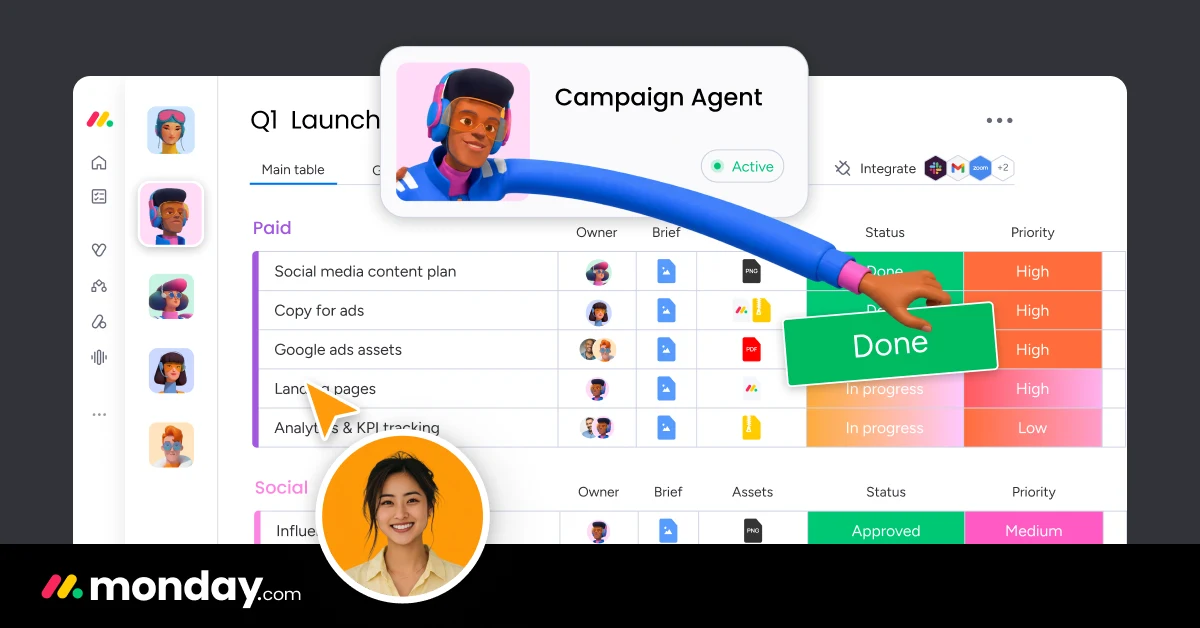
Is monday.com a good fit for a marketing agency?
It is, on one condition: the agency buys it for delivery visibility, not for marketing. The Monday-morning question in an agency is never “is the creative good?” — the creative is usually fine. The question is “which of our twelve clients has work stuck in approval, who is carrying three launches this week, and what is the client actually waiting on from us?” A spreadsheet answers that question on Monday morning and lies about it by Wednesday. A Monday board answers it every time someone opens it.
That is the whole pitch, and it is a good one — provided nobody in the agency mistakes it for a bigger one. Monday will not buy media, write the ad, build the client portal or send the invoice. It will show you, in colour, that the retainer client has been “waiting on approval” for nine days while the same designer quietly went overdue on two other accounts. Agencies that already own their creative tools and their ad platforms and still lose track of the delivery are exactly the agencies Monday helps. Agencies looking for one system to run the whole business should keep looking — the comparison below is blunt about where Monday stops.
The five jobs Monday actually does for an agency
1. Campaign and client-delivery boards. One board per client, or one board per campaign with a group per client — either shape works, and the choice matters less than the discipline: every deliverable gets a row, an owner, a due date and a status. Filter by “due this week” and the account-management meeting writes itself. The ironic part: the agencies that need this most are the ones whose delivery status currently lives in one heroic account manager's head, in one Slack channel, on one laptop.
2. Creative-intake forms. A form turns “can you just knock up a quick social post?” from a Slack message into a brief: objective, audience, asset type, deadline, approver, files attached. Every request arrives in the same shape, on the same board, in the same order — and a vague brief is visible as a vague brief instead of discovered halfway through design.
3. Approval flows. When an asset's status flips to “ready for review”, Monday can notify the approver, wait a set number of days, and chase again — then escalate to the account manager when nothing arrives. This is approval tracking, not a client portal: the client approves on a board they were invited to, not inside a branded experience built for them. That distinction is the whole honest-limit section below, and it decides whether Monday fits a given agency.
4. Client dashboards. A dashboard rolls the status of every board for one client — or every client for one account manager — into a single view: what is live, what is in approval, what is overdue. The client sees progress without a status call, and the account manager stops writing the same “here is where everything stands” email every Friday. The dashboard reports on Monday's work; ad-platform results still live in the ad platforms unless connected through integrations.
5. Workload across accounts. The workload view (Pro plan) shows who is carrying what across the whole book, so the studio lead can see that one designer has three launches due in the same week while another has one — before anyone burns out or a launch slips. This is the feature that justifies Pro for an agency with more than a handful of accounts; on Standard, you are guessing at capacity.
What an agency delivery flow looks like
Brief in, tasks out, approval gated, live work reported — the diagram below is the shape of it. The example is illustrative, but the shape is the point: nobody has to ask anyone anything to know where the work stands.
Example delivery flow only. Stage names and client accounts will differ in a real agency.
What it costs — and which plan an agency actually needs
Prices below are monday.com Work Management, US edition, per seat per month on annual billing, checked against monday.com/pricing on 24 October 2026. Paid plans start from 3 users, annual billing saves 18% against monthly billing, and there is a 14-day Pro trial. Monthly-billing figures are not printed here: monthly costs more, and the figure shown on the pricing toggle when you sign up is the one that counts.
| Plan | Annual price | What an agency gets | The catch |
|---|---|---|---|
| Free | $0 | Up to 2 seats, up to 3 boards | A solo test drive, not an agency system — three boards do not cover a client list |
| Basic | $9 / seat / mo | Unlimited boards and items, 5 GB storage | No automation allowance worth relying on for approval chasing |
| Standard | $12 / seat / mo | Timeline and Gantt views, calendar view, guest access, 250 automation actions and 250 integration actions a month | The 250-action allowance is the ceiling: approval reminders across a dozen clients can chew through it |
| Pro | $19 / seat / mo | Private boards, time tracking, formula and dependency columns, 25,000 automation actions and 25,000 integration actions a month, workload view | The plan most agencies with a real client list actually need |
| Enterprise | Custom | Enterprise-scale automations (250,000 actions a month), advanced security and governance, multi-level permissions | A sales conversation, not a self-serve plan |
A note on the automation cliff: Standard's 250 actions a month sounds generous until every approval reminder, status change and notification counts against it. An agency running approval chasing across a dozen clients should price Pro from the start rather than discovering the limit mid-campaign. And the 3-seat minimum bites small agencies hardest: a two-person agency on Standard pays for three seats whether the third chair is filled or not.
Do not confuse Work Management with monday CRM
Monday sells more than one product under one brand, and the pricing pages are separate for a reason. Monday CRM is billed separately — Basic $12, Standard $17 and Pro $28 per seat per month on annual billing, with an Ultimate tier on custom pricing. An agency that wants pipeline tracking for winning new clients on top of delivery boards is buying two products, not one plan. For most agencies, Work Management is the purchase; CRM only enters the conversation if the agency is actively running a sales pipeline, which is a different job from delivering the work.
The honest limit: guest access is not a client portal
This is the section to read before showing Monday to a client. Guests invited to a board on Standard and above can see that board, follow its status and — where permissions allow — move work through approval. Viewers are free on paid plans. What guests do not get is a client portal: no branded client login, no polished report hub, no document-signing flow, no billing. A client who opens Monday sees your working board, with all the honesty and all the rough edges that implies.
For many agencies that is fine — arguably better than fine, since the client sees real progress instead of a curated report. For agencies whose pitch includes a white-label client experience, it is a deal-breaker, and no amount of board tidying fixes it. The right question is not “can clients see Monday?” but “are we happy for clients to see how the work actually looks?” If the answer is yes, guest access is a strength. If the answer involves the words “white-label”, buy a portal and let Monday be the delivery engine behind it.
| Job | Monday.com | What to pair it with |
|---|---|---|
| Seeing all client work and campaigns | Wins — flexible boards, dashboards, workload view | Nothing — this is Monday's job |
| Client portal experience | Not included — guests on a board are not a portal | A dedicated client portal or reporting tool, if the pitch needs one |
| Creative production | Tracks it — does not make it | Design and copy tools, as before |
| Media buying & ad reporting | Not included — ads live in the ad platforms | Google, Meta and other ad platforms, plus integrations where useful |
| E-signatures & billing | Not included — use separate tools | E-signature tool and accounting software |
| Winning new clients | Work Management tracks delivery, not pipeline | Monday CRM (billed separately) or HighLevel for front-office follow-up |
No prices are printed for the paired tools here: their plans and tiers change, and a stale price helps nobody. Check their current pricing pages before comparing totals.
Monday vs HighLevel: delivery vs front office
Agencies comparing Monday with HighLevel are usually comparing two different halves of the business. HighLevel runs client acquisition and follow-up: capturing enquiries, booking discovery calls, nurturing prospects and asking for reviews. Monday runs the delivery work: the campaign boards, the creative intake, the approval chase and the client dashboard once someone is already a client. An agency can reasonably use both — HighLevel up to the signed retainer, Monday from the retainer onwards — and the handoff between them is the design decision worth getting right. If the agency only has one of the two problems, buy the tool for that problem and skip the other.
A sensible agency stack
Design, copy and the ad platforms themselves — where the work is made and where it runs. Monday tracks this work; it does not replace it.
Retainers, invoices and reporting live in the accounting system, not on a delivery board.
Runs every client board, campaign, intake form, approval flow, client dashboard and workload view across the whole book.
Only if winning new clients is itself a process: enquiry capture, discovery-call booking and prospect follow-up.
Notice what is not in the stack: a spreadsheet — or a Slack channel — as the system of record for delivery. That is the thing Monday replaces, and it is a replacement worth making even if nothing else changes.
monday.com review → · Monday.com buyers guide → · How much does Monday.com cost? → · Marketing agency software stack → · HighLevel for marketing agencies →
Who should test it first?
Small agencies drowning in spreadsheets and Slack threads. If delivery status lives in one person's head or one channel, Monday's board is an immediate upgrade — even on Standard, even before any automation is built.
Growing agencies with a real client list. The workload view on Pro earns its keep the first time it stops a studio lead assigning a third launch to someone already carrying two. Price Pro, not Standard, if cross-account capacity is the problem.
Agencies happy for clients to see the real board. If guest access feels like transparency rather than exposure, Monday slots in cleanly as the delivery layer. If the pitch needs a branded portal, solve that first — a board will not become one.
How to test monday.com in 14 days
- Build one board for a single real client account — every live campaign on it, with owners, due dates and statuses.
- Route one real creative request through an intake form, from brief to delivered asset, and check the brief arrives complete.
- Run one approval flow end to end: asset to “ready for review”, reminder sent, client approves on the board.
- Invite one friendly client as a guest and ask them, honestly, whether the board feels like transparency or like homework.
- Build the client dashboard for that account and run one weekly review from the dashboard alone.
- On Pro, open the workload view in a busy week and check whether capacity surprises anyone.
- Count your automation actions after a week and project the month — that number decides Standard vs Pro.
Monday.com for marketing agencies: bottom line
Monday.com is the flexible generalist, and generalists should be judged on the job they actually do. For a marketing agency, that job is seeing the delivery: every client, every campaign, every approval chase and every overloaded team member, on one board, without a status meeting. It buys no media, designs nothing, portals nothing and bills no one — and an agency that buys it with those expectations will blame the tool for a purchase decision it never made. Bought for delivery visibility, though, it is the rare piece of software whose value shows up in the first busy week: fewer “where are we on this?” messages, fewer approvals discovered late, and an account meeting that finally starts from the board instead of from memory.
Start on the 14-day Pro trial, build one real client board, and let the workload view and the automation count tell you which plan the agency actually needs.
Monday.com for marketing agencies: FAQs
Is monday.com a client portal for agencies?
No — and this is the limit to understand before you buy. Guests can be invited to specific boards on Standard and above, and viewers are free on paid plans, but a guest sees boards, not a polished portal: there is no branded client login, no document-signing flow and no billing. If clients need a branded place to approve work, view reports and pay invoices, that is a separate tool; Monday is the delivery board behind it.
Can clients approve creative work in monday.com?
Yes, after a fashion. A client invited as a guest to a delivery board can see the asset, the status and the due date, and move it through an approval status where permissions allow. What they cannot do is walk into a branded portal built for them. For many agencies that board-level approval is enough; for agencies selling a white-label client experience, it is not.
Which monday.com plan should a small agency start on?
Standard at $12 per seat per month on annual billing is the sensible starting point for most small agencies: timeline and Gantt views, guest access and automation allowances. Basic at $9 has no automations worth relying on for approval chasing, and the workload view that matters when one designer is spread across five accounts sits on Pro at $19.
Does monday.com replace monday CRM for an agency?
No. Monday CRM is billed separately — Basic $12, Standard $17 and Pro $28 per seat per month on annual billing, with an Ultimate tier on custom pricing. Work Management runs delivery; CRM runs the sales pipeline. An agency winning new business and delivering it is buying two products, not one plan, if it wants both jobs done in Monday.
How does monday.com handle workload across several client accounts?
As one view over many boards: each account gets its own board or group, every task has an owner and a due date, and the workload view (Pro plan) rolls capacity up across all of them. That is how an account manager spots that the same designer is due on three launches in the same week — before the week in question, rather than during it.
Can I pay monday.com monthly instead of annually?
Yes — monday.com offers month-to-month billing alongside annual billing, and annual billing saves 18% against the monthly equivalent. This page prints annual figures only; check the pricing toggle for the current monthly figure before you buy, and remember paid plans start from 3 users.
Sources and editorial notes
This page is an editorial desk-research guide, not a hands-on product test. Work Management prices were checked against monday.com/pricing on 24 October 2026 and are shown for the US edition on annual billing; prices, plan limits and offers change over time — the figures shown when you sign up govern. Monthly-billing figures are not printed here. Monday CRM prices are shown from monday.com/crm on the same basis.